Friday, August 11, 2017

NYC Day 55: In Which I Am Once Again Spoilt For Choice in The Big Apple

Dive Bomber and Tank (1940), by Jose Clemente Orozco
Click on images to view full size
...
I had eight events listed as potential activities for this day, and one of them was not a return to the Museum of Modern Art, but there I was, being drawn back to that venerable institution on 54th Street once again. This post features works from the Mexican Modernists room.

MEXICAN MODERNISM
After the Mexican Revolution (1910-1920), the new government of Mexico instituted a program to celebrate the nation's indigenous heritage and recent history. Artists were central to this initiative, designing and creating large-scale murals that often monumentalize their subjects, portraying both recognizable historical figures and common peasants and workers as symbols of strength in the face of adversity.

Through the support of the Museum of Modern Art's cofounder Abby Aldrich Rockefeller, Diego Rivera and Jose Clemente Orozco were invited to New York in 1931 and 1940, respectively, to make frescoes in work spaces provided by the Museum. Also in New York, in 1936, David Alfaro Siqueiros, interested in innovative materials and techniques, founded the Siqueiros Experimental Workshop, whose membership included Jackson Pollock. Driving these artists, as Siqueiros explained, was the imperative to create "a fighting educative art for all."


Above: full painting, and below, a detail from Ethnography (1939), by David Alfaro Siqueiros 


DAVID ALFARO SIQUEIROS (1883-1949)
Of Los tres grandes (The Big Three) Mexican muralists, Siqueiros was the youngest and the most politically radical. His artistic career was repeatedly interrupted by his fervent political activity and frequent imprisonment. Siqueiros believed that revolutionary art called for revolutionary techniques and materials. Collective Suicide features several innovative techniques the artist explored as part of the Siqueiros Experimental Workshop he founded in New York in 1936. He airbrushed paint across the top third of the panel and used stencils to depict the army of invading seventeenth-century Spanish conquistadors on horseback (lower right) and Chichimec Indians leaping to their deaths to avoid subjugation (left). The swirling vortexes are pools of fast-drying commercial lacquer typically used on cars. A member of the workshop later recalled that they applied this paint "in thin glazes or built it up into thick gobs. We poured it, dripped it, splattered it,  and hurled it at the picture surface." Siqueiros's radical experiments proved influential for Abstract Expressionist artist Jackson Pollock, in particular, who was a member of the workshop.


Above: Full painting, and below, details of David Alfaro Siqueiros's, Collective Suicide (1936).


...


Above: Jose Clemente Orozco's, Zapatistas (1931) 


DIEGO RIVERA (1886-1957)
Dedicated to the slain revolutionary hero Emiliano Zapata (1879-1919) and the campesinos, or peasant farm workers, who followed him, this fresco is a copy of a detail from a larger mural cycle Rivera made in Cuernavaca, Mexico, a few years earlier. It is one of eight "portable" frescoes Rivera produced expressly for his solo exhibition at MoMA in 1931. In a studio the Museum provided him above its galleries, he worked around the clock for a month to produce frescoes that, unlike traditional frescoes, were intended to be transportable. The works demonstrate Rivera's mastery of the medium and were a critical and popular success. During its five-week run, the exhibition broke Museum attendance records and led to important public commissions from the Ford and Rockefeller families.
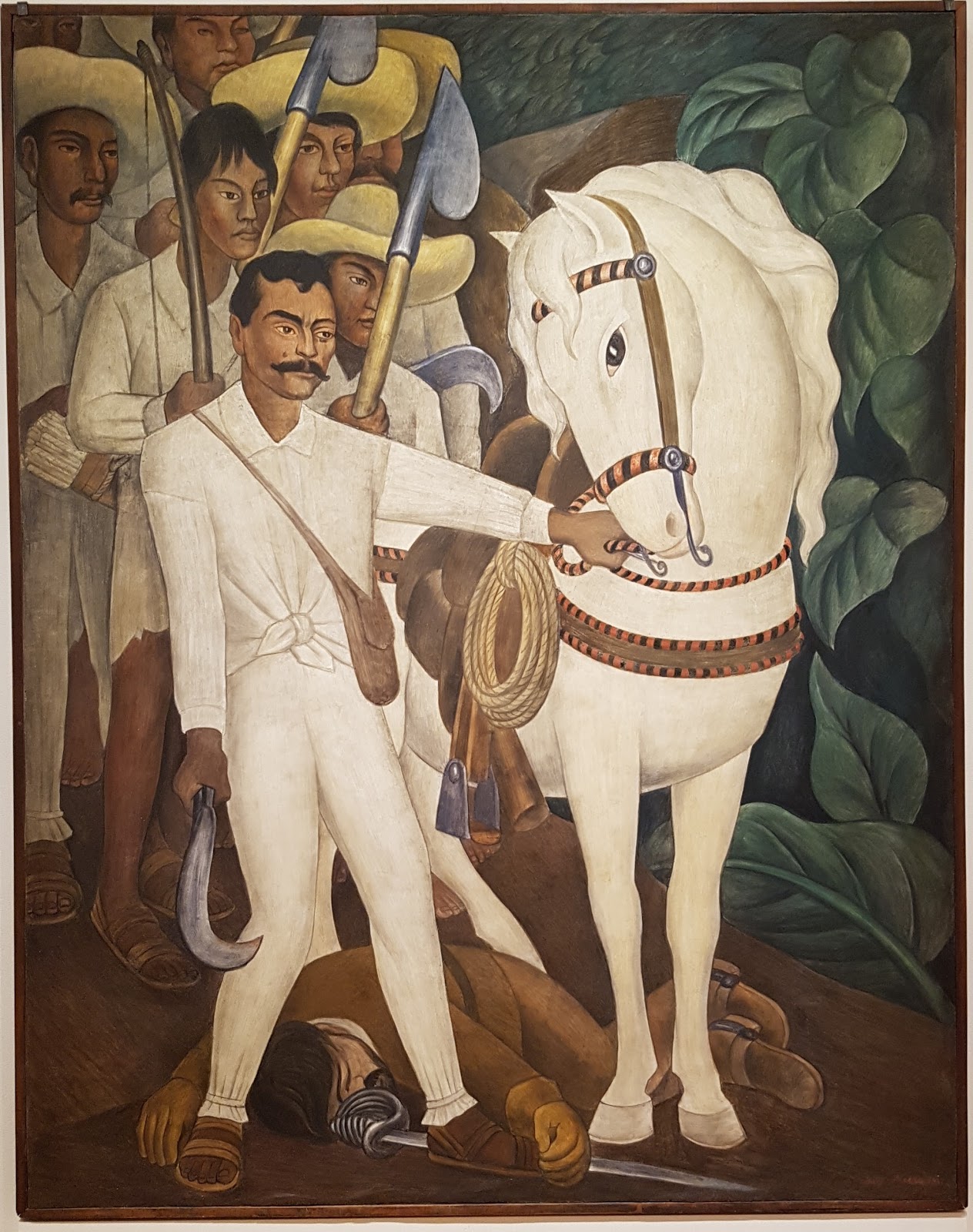

Above: The full painting, Agrarian Leader Zapata (1931), and below, a detail from the work.


FRIDA KAHLO (1907-1954)
Kahlo collected eighteenth- and nineteenth-century Mexican retablos -- small paintings on metal made as Catholic devotional objects -- and adopted the medium as her own. In this fantastical family tree, Kahlo depicted herself as a fetus in utero and as a child inside her childhood home. While Kahlo celebrated Mexican culture by evoking its traditions in her art and wearing elaborate traditional attire, this painting is as much a tribute to her European and Jewish heritage. On the right is her German-born Jewish father and his parents, symbolized by the sea, and on the left her Mexican mother and her parents, symbolized by the land and a faintly rendered map of Mexico that appears above her grandparents' heads. Kahlo made this painting shortly after Hitler passed the Nuremberg Laws, forbidding interracial marriage. While the painting adopts the format of genealogical charts used by the Nazis to advocate racial purity, Kahlo uses it subversively to affirm her mixed origins.

My Grandparents, My Parents, and I (Family Tree), 1936, by Frida Kahlo

Fulang-Chang and I depicts Kahlo with one of her pet monkeys, interpreted by many as surrogates for the children she and Diego Rivera were unable to conceive. The painting was included in the first major exhibition of her work, held at Julien Levy Gallery in New York in 1938. In the essay that accompanied the show, the Surrealist leader André Breton described Kahlo's work as "a ribbon around a bomb" and hailed her as a self-created Surrealist painter. Although she appreciated his enthusiasm for her work, Kahlo did not agree with his assessment: "They thought I was a Surrealist but I wasn't. I never painted dreams. I painted my own reality." Kahlo later gave this painting to her close friend Mary Sklar, attaching a mirror to it so that, if Sklar chose, the two friends could be together.


Fulang-Chang and I (1937, assembled after 1939)

====================================
Wednesday 9, August | Expenses $27.05 ($34.30)
====================================

Note: All biographical and interpretive information in this post is sourced from the Mexican Modernism room at the Museum of Modern Art.

Any questions, comments or suggestions? How about complaints or compliments? Let me know via the comments box below.

Thursday, August 10, 2017

NYC Day 54: In Which I Go in Search of Pre-Revolutionary America


Three views of the Morris-Jumel Mansion
Click images to view full sized
...
It may surprise you, dear reader, that in amongst the soaring skyscrapers that dot the New York City skyline, there are to be found numerous buildings and homes that reach back to before the American Revolution. I know that may seem preposterous; that a city as dynamic and as ever changing as New York City, somehow retains vestiges of it's revolutionary past.

One of those buildings is the Morris-Jumel Mansion, located on an acre or two of land in upper Manhattan, overlooking the East River (at 65 Jumel Terrace). I mention the acreage specifically because the former estate on which the mansion now stands once stretched across Manhattan from the Hudson River to the East River, and from approximately 168th Street down to 158th.

The Mansion today is part of the Jumel Terrace Historic District, a small historic district in the Washington Heights neighborhood of Manhattan.
It consists of 50 residential rowhouses built between 1890 and 1902, and one apartment building constructed in 1909, as the heirs of Eliza Jumel sold off the land of the former Roger Morris estate. The buildings are primarily wood or brick rowhouses in the Queen Anne, Romanesque and Neo-Renaissance styles. {Wikipedia...] 
An information sheet at the Mansion provides additional information:
The Morris-Jumel Mansion, Manhattan's only remaining Colonial residence, is unique in its combination of architectural and historical significance. Built as a summer "villa" in 1765 by the British Colonel Roger Morris and his American wife Mary Philipse, it originally commanded extensive views in all directions: of New York harbor and Staten Island to the south; of the Hudson and Harlem rivers to the west and east; and of Westchester county to the north.
Colonel Morris was the son of the famous architect Roger Morris, a fact which may explain the extremely innovative features of the Mansion such as the gigantic portico, unprecedented in American architecture, and the rear wing which was the first octagon built in the Colonies.
Above: Interior of the octagonal Drawing Room, and below items within the room,

 A painting of Aaron Burr, by George Hans Eric Maunsbach

Empire Sofa, c.1825

Painting of Eliza Jumel by an unknown artist.
...
The house's situation and large size made it ideal as military headquarters during the Revolution, and it was occupied successively by Washington, General Sir Henry Clinton, and the Hessian General Baron Von Knyphausen. As the Morrises were loyal to Britain during the Revolution, their property was seized and sold after its conclusion. In 1790 Washington returned for a cabinet dinner at which he entertained Jefferson, Adams, Madison, Hamilton, and Colonel Knox, among others.
The later history of the house centers on the Jumels, Stephen Jumel was a wealthy French emigre who married, in 1804, his beautiful and brilliant mistress, Eliza Bowen. They bought the Mansion in 1810. In 1815 they sailed to France, and offered Napoleon safe passage to New York after Waterloo. although he eventually declined the offer, they did acquire from his family many important Napoleonic relics - some of which can be seen in the blue bedroom on the second floor. Stephen died in 1832 and Eliza married the ex-Vice-President, Aaron Burr in the front parlor a year later. On her death in 1865 she was considers one of the wealthiest women in America.

Above and Below: The kitchen situated in the basement.


...
It should be said that today the Mansion is in dire need of an extensive (and no doubt expensive) upgrade of its exterior facade. The staff member I was taking to described a complicated arrangement with a government heritage department which divides responsibility for the buildings maintenance thus: the non-profit group managing the site is only able to renovate and fix the interior of the building, while the government agency is responsible for the exterior. This has led to a situation in which the interior is progressively being upgraded, while the exterior of the building appears run down, and in desperate need of maintenance, including and a fresh paint job.

I don't know how many of the fittings and items of furniture currently on display in the Morris-Jumel Mansion are original to the building, but as a 'work in progress', it was sobering to walk in the footsteps of George Washington, and some of the other leaders of the American Revolution for an hour or so, and to try and imagine the scenes playing out inside the Mansion more than 200 years ago..

Above and Below: A series of photos representing Washington's War Room.


...
A special bonus for visitors who make the trip uptown to see the Morris-Jumel Mansion is the chance to walk along one of the most unique streets in the whole of New York City; and that is the incredible time warp that is Sylvan Terrace.


...
Sylvan Terrace, located where West 161st Street would normally be, was originally the carriage drive of the Morris estate. In 1882-83 twenty wooden houses, designed by Gilbert R. Robinson Jr., were constructed on the drive. Initially rented out to laborers and working class civil servants, the houses were restored in 1979-81. They are now some of the few remaining framed house in in Manhattan. {Wikipedia...]

...
===================================
Tuesday 8, August | Expenses $86.80 ($110.25)
===================================

Any questions, comments or suggestions? How about complaints or compliments? Let me know via the comments box below.

NYC Day 53: In Which I Give Thanks For a Rainy Day Monday

The cover of my edition of The Bell Jar
...
Unusually for New York City, it rained all day today. Unusual, because generally the storm clouds and the rain that accompanies them generally move on after a few hours, leaving the streets of the city washed relatively clean for a day or two, before they are once again covered with a layer - or layers - of the daily grime that never seems to get completely washed away, no matter how severe the downpour.

To be honest, I was grateful for the excuse the rain gave me to stay in. In fact, I did not step foot outside the apartment all day. I did consider going out for dinner, but in the end I couldn't be bothered making the effort to do even that. So I cooked my own (spaghetti, garnished with spiced Moroccan olives, and spaghetti sauce straight out of a jar).

I spent the day updating this blog, and reading. I finished my 29th* book for the year, Sylvia Plath's only full length novel, The Bell Jar. My delight in the book was tempered by the knowledge that Plath took her own life at the age of 31, and that with this final act, the literary world will never know just how many other great novels she may have written if she had chosen to live.
Sylvia Plath (October 27, 1932 – February 11, 1963) was an American poet, novelist, and short story writer. Born in Boston, she studied at Smith College and Newnham College at the University of Cambridge before receiving acclaim as a poet and writer. She was married to fellow poet Ted Hughes from 1956 until they separated in September 1962. They lived together in the United States and then in England and had two children, Frieda and Nicholas. Plath was clinically depressed for most of her adult life, and was treated multiple times with electroconvulsive therapy (ECT). She committed suicide in 1963. Plath is credited with advancing the genre of confessional poetry and is best known for two of her published collections, The Colossus and Other Poems and Ariel, and The Bell Jar, a semi-autobiographical novel published shortly before her death. In 1982, she won a posthumous Pulitzer Prize for The Collected Poems. [Source: Wikipedia...]
What a brilliant tour de force of a debut novel The Bell Jar is. The book is essentially a memoir of the first 20 years of her life. So personal is her writing, that it was not meant to be published in America until Plath's mother had herself passed away, which given her mothers relatively young age, would have potentially been many years after Sylvia had died. In the end, the book had become so popular in Britain (where Plath was living at the time), that when illegally imported copies of the book began turning up in the US, following Plath's death, the publishers had no choice but to release the book there, or face the prospect that some other publisher would do so.

One of the few available photos of Sylva Plath
...
The Bell Jar is one of those books that seems to be name-checked by many other writers and artists, and it was way past time I got around to reading it. The book is beautifully written, with her prose reflecting her other great skill as a poet.

Plath spent a month in New York City when she was 19 as part of a placement with a women's magazine. She writes extensively about this period in The Bell Jar, and the following quotes, which capture aspects of New York perfectly, come from this time.

I have written in previous posts about the drenching downpours of rain that hit New York City from time to time, but none of my descriptions come close to this passage from Sylvia Plath:
"When we came out of the sunnily lit interior of the Ladies' Day offices, the streets were gray and fuming with rain. It wasn't the nice kind of rain that rinses you clean, but the sort of rain I imagine they must have in Brazil. It flew straight down from the sky in drops the size of coffee saucers and hit the hot sidewalks with a hiss that sent clouds of steam writhing up from the gleaming, dark concrete."
Or this spot on observation about another of my persistent complaints regarding the city's summer heat:
"I didn't realize Lenny's place had been air-conditioned until I wavered out onto the pavement. The tropical, stale heat the sidewalks had been sucking up all day hit me in the face like a last insult."
Noting that she had been the same weight for ten or more years, Plath writes that she had no problem eating as much as she liked compared to her associates:
"I made a point of eating so fast I never kept the other people waiting who generally ordered only chef's salad and grapefruit juice because they were trying to reduce. Almost everybody I met in New York was trying to reduce."
After a wild night out with fellow interns, Plath and one of the other females throw up in a taxi on the way back to the hotel, causing Plath to observe:
"There is nothing like puking with somebody to make you into old friends."
Like Jean Rhys's book, Wide Sargasso Sea, this book too is a real 'keeper'. Not only will I make a point of reading it again, but I will also seek out copies of her collected poems when I next visit Strand Books or the Housing Works Book Store.

============================
Monday 7, August | Expenses $00.00
============================

*29th book. With regard to counting the number of books I am reading: I began the year with a self-imposed 52-Book-Year Challenge, the goal of which is to read an average of one book per week during 2017. Hence, Sylvia Plath's The Bell Jar, is book 29.

Any questions, comments or suggestions? How about complaints or compliments? Let me know via the comments box below.

Tuesday, August 8, 2017

NYC Day 52: In Which I Delight in The Next Generation of Broadway Performers

Broadway's Next Generation take a well deserved curtain call
...
Broadway Artists Alliance: Broadway's Next Generation Students
In spite of a general feeling of tiredness and subsequent lack of energy, I went out this afternoon to catch, Broadway Artists Alliance Presents: Broadway's Next Generation, at the Peter Jay Sharp Theatre at Symphony Space (at 2537 Broadway, New York).
Overview: Broadway Artists Alliance: Broadway's Next Generation Students from all across the country have been hand selected to study with top Broadway Mentors throughout the summer here in the heart of New York City. In this fast paced showcase of Broadway's Best, enjoy your favorite Musical Theatre repertoire from traditional to current and upcoming works performed by Broadway's Next Generation of talented young performers ages 10-21.
As if to test my resolve and commitment to the event, I had to walk over the 191st Street 1-train subway station to make the run to the 96th Street station. On reaching the 191st station, I found that subway trains were not running that far this weekend due to the never-ending track work that plague's the city's subway system. There was nothing for but to either give up, or find another way of getting to the theatre. Not to be thwarted, since I had gone to the trouble of getting dressed for an outing, I caught an M100 bus to the 168th Street subway station from which I boarded a C-train to 96th Street. From there I walked the three blocks to Broadway, arriving at the theatre about ten minutes into the showcase.

I quickly settled in to watch the show, and was immediately delighted with my decision to persist in my attempt to reach the venue. In a fast paced series of performances, some lasting less than a minute, a string of young talent sang, danced, tapped, and performed short monologues that left me in awe of their fearlessness. That children as young as ten could walk out onto a huge stage in a darkened theatre, announce their names in clear strong voices, and then sing or recite their chosen monologues with the power and confidence of seasoned professionals, was quite simply, awe inspiring.

My only disappointment with the night was with the double-sided single sheet of program notes. While it include small photographs and the names of each of the approximately 140 performers, it did not include a complete list of the songs and the shows from which they were taken. Nevertheless, by looking carefully at the small images of each participant, and before my memory begins to fail me, here are some names that are definitely worth remembering: among the youngest performers were Michael Ross, Sammy Ramirez, Amanda Wylie, and Gentry Claire Lumpkin.

Among the teenagers and young adults, names to watch out for are Nicholas Biddle, Sofia Baturina, and Adrian Villegas. But why try and choose favorites when any one of these amazing young people will surely be staring on Broadway, or any one of a hundred other stages over the next few years.

This incredible two hour showcase of new talent was completely free, and as if to test the resilience of the young performers, two concerts were scheduled for the evening; one at 5:00pm, with a repeat performance at 8:00pm. Because I missed the opening ten minutes, I stayed for the 8:00pm show, but left at the intermission. While the major dance routines were repeated for the second show, some new songs and monologues were introduced to provide variety for the audience -- which consisted mostly of family and friends of the young performers, and no doubt industry professionals who had come along to check out the latest talent. And there was more than enough of that on show.

Sadly, my knowledge of the vast repertoire of Broadway musicals is, to be blunt, quite limited. However, of the musicals I did recognize, songs and dance routines came from A Chorus Line, Beautiful, School of Rock, Matilda, Charlie and The Chocolate Factory, and Les Miserables.

Soloists were accompanied by a pianist placed not quite off-stage, while large ensemble dance numbers were performed to pre-recorded music, or music from Broadway soundtrack albums. In the more than three hours of live performance that I enjoyed, the only slip up occured when one of the tap dancers lost her footing and slipped on stage. However, she was up instantly and resumed her place in the line liked the true professional she is destined to become.

These Broadway Artist Alliance showcases are held each year following the intensive summer school the alliance organizes, and I have no hesitation in urging New Yorkers, or visitors to the city to attend one of the showcases when the opportunity presents itself.

Watch a video montage from a previous BAA Showcase via this link...

More Information
Broadway Artists Alliance... 

NYC Days 50 & 51: In Which I Indulge Myself in Movies and Music

Click images to view full sized.
...

All work and no play makes Jim a dull boy - or words to that effect. Not that I have worked for the past six or seven years, but I'm sure you get my drift. There are only so many masterpieces that one can fake interest in before your eyes glaze over and Masterpiece Fatigue sets in, and it's time for coffee and cake.

Thus it was that on days 50 and 51 in the Big Apple I indulged in my love of movies and grabbed the opportunity to catch up on some recent (and not so recent), films which were being screened as part of the Museum of Modern Arts year round film schedule. For reasons I can't fully explain, I did not attend any of these film screenings during June or July, but now that I have immersed myself in endless rounds of art, I have gone through MoMA's film schedule for August, and I intend to see a bunch of movies that I have either missed or which I want to see again.

I should point out the screenings come with standard MoMA membership, so there is no additional $12.00 cost to me (yes, I am a member).

Above: A production still from Werner Herzog's Fata Morgana. 
Below: A production image from Herzog's Lessons Of Darkness
...

To date I have seen two Werner Herzog films, Fata Morgana, (1971) and Lektionen in Finsternis (Lessons of Darkness), from 1992. In Fata Morgana, Herzog makes desert mirages palpably real through sound and image in this hallucinatory walkabout across the shimmering Sahara. The filmmaker would later observe, “[E]ven though obviously shot on Earth, the film does not necessarily show the beauty and harmony and horror of our world, rather some kind of a utopia—or dystopia—of beauty and harmony and horror. When you watch Fata Morgana you see the embarrassed landscapes of our world, an idea that appears repeatedly throughout my work, from The Enigma of Kaspar Hauser to Pilgrimage [to Lessons of Darkness].”

In Lessons of Darkness, Herzog examines the devastating after effects of the first Gulf War (August 2, 1990 to February 28, 1991), which came about due to the stupidity and megalomania of Saddam Hussein after Iraq - under his leadership - launched an invasion against Kuwait. In this short 54 minute film, Herzog focuses his lens on the campaign to extinguish some 700 oil well fires which had been lit by retreating Iraqi forces. If ever there was a vision of hell on earth, this film captures it in all its raging, scorched earth and sky blackened horror.

Alicia Vikander in a still from Ex Machina 

Two more recent films which escaped my attendance when they were first released are Jonathan Glazer's Under The Skin, starring a very un-alien-like Scarlett Johansson, and Ex Machina, written and directed by Alex Garland in 2014.

In Ex Machina, a very alien-looking Alicia Vikander is joined by a small but stellar cast which includes Oscar Isaac, and Domhnall Gleeson. In the film, Garland reimagines the Frankenstein myth where Oscar Isaac seems to have built the perfect humanoid, which he calls Ava - brilliantly portrayed by Vikander. He engages a young coder (Gleeson) to test Ava over the course of a week, and these sessions with her form the basis of the film and the drama that follows. I agree fully with the program notes that state: Ex Machina quickens the mind and body. It is one of those rare films that is as intellectually and morally upsetting as it is erotic.

Scarlett Johansson in a still from Under The Skin

Under the Skin, Jonathan Glazer's 2013 film, has the always wonderful Scarlett Johansson driving a large white van around the wilds of the Scottish highlands and the even wilder nocturnal streets of an unnamed Scottish city, collecting male specimens for some unknown alien race. The men she selects are invariably single, and loners or outsiders living on the edges of society. Her work is overseen by first one, then apparently four aliens who clean up after her collecting expeditions are completed.

We learn nothing about her origins, or why she and her helpers are collecting males in particular, and not females. Neither do we know what happens to the males, once they have been processed. Things proceed smoothly enough with the collecting expeditions until a moment of compassion on Johansson's part starts to unravel her mission, and the film moves on to its final confrontation.

I remember reading about the film when it was released early in 2014, and was fascinated to learn that many of the males that appear briefly in the film were complete novices. In fact, a number of them were picked up at random by Johansson as she drove around in the van, and their interactions were filmed secretly with hidden cameras. One clue as to which of these men are the random pickups, is their almost unintelligible Scottish accents. The few professional actors in the film, whether Scottish or otherwise are easily understood.

Bollywood Boulevard performers dancing up a storm
...
As for the 'Music' component of this post and my activities over these two days, I continue to enjoy the wonderful variety of acts that are part of this year's Lincoln Center Out Of Doors program. These include the colorful and dynamic dancing during the Bollywood Boulevard evening on Thursday, August  3. This evening was subtitled A Journey Through Hindi Cinema, and while I am not an aficionado of the Bollywood movie scene, there is no doubt that these films are incredibly popular. The evening traced the evolution of Bollywood, from black-and-white classics to colorful blockbusters, and brought "the spirit and romance of India’s grand palaces, mountain vistas, and sweeping mustard fields to Damrosch Park."

I also attended, though it has to be said, briefly, the New York premiere of Miguel Atwood-Ferguson: Suite for Ma Dukes.
New Yorkers can finally experience this towering orchestral tribute to the music of composer, producer, and rapper J Dilla, who produced groundbreaking records for De La Soul, Erykah Badu, and Common, among others, and whose impact is still felt today over ten years since his death at age 33. Heard through the prism of classically trained composer and violinist Miguel Atwood-Ferguson’s expansive orchestral arrangements and producer Carlos Niño’s musical direction, Dilla’s works explode in scope, untethered from any era or genre and bursting with rhythmic and melodic invention.
Sometimes I worry that I am not as sophisticated musically and artistically as I like to think I am, and it is for this reason that I did not stay the distance and take in the full program of music that was presented during this event. I have written elsewhere that hip hop and rap are musical forms that I least enjoy, and I'm sure this is partly because I have never made a serious attempt to understand them. Until I Googled for 'J Dilla', I had never heard of the name, nor was I familiar with any of his production or recording credits, so I had no emotional connection with the music emanating from the stage, despite the excellence of the orchestrations and the skills of the many musicians performing the new arrangements.

Which brings to my latest night out on Day 51, and another Lincoln Center Out Of Doors concert, this time featuring the songs of the silver-haired British music legend, Nick Lowe.

Nick Lowe and the leather-clad Los Straightjackets going through their paces

Billed as Nick Lowe's Quality Rock 'n' Roll Revue, Lowe was backed by a four piece group out of Nashville going by the name Los Straightjackets, who, despite their well dressed attire, wore leather headgear of the type one finds in stores that specialize in fetish wear (the program notes describe them as "luchador-masked") Why four excellent and clearly talented musicians should feel the need to mask their faces with this type of gear is beyond me, but I guess it sets them well apart from the competition, and it certainly gets them the attention they are looking for. But back to Nick Lowe.

Lowe rose to fame in the late ’70s with his Top 40 single Cruel to Be Kind, and since then he has become a venerated songwriter, and producer of classic albums by Elvis Costello, Graham Parker, and The Pretenders. Nick Lowe first came to my notice with his debut album, Jesus Of Cool, released in 1978. For me, this album has now reached Classic Album status, and I find it just as enjoyable to listen to today, as I did when I first heard it all those years ago. I was delighted therefore when he included the song, So It Goes from that album, along with a host of later hits - and near misses - from his 40 year career in popular music.

And that dear reader, brings to a close my seventh week in New York City


WEEK SEVEN EXPENSES*
===================================
ONGOING WEEKLY EXPENSES
===================================
Museum Memberships $19.15 ($25.15)
AT&T SIM card $16.25 ($25.38)
MTA Pass $30.25 ($39.92)
Accommodation $152.00 ($200.00)
===================================
Total Ongoing: US$217.65 (AU$290.45)
===================================

ADDITIONAL DAILY EXPENSES
===================================
Sunday 30, July | Expenses $13.25 ($16.60)
Monday 31, July | Expenses $101.40 ($127.10)
Tuesday 1, August | Expenses $50.50 ($63.50)
Wednesday 2, August | Expenses $29.70 ($37.35)
Thursday 3, August | Expenses $19.50 ($24.50)
Friday 4, August | Expenses $24.10 ($30.40)
Saturday 5, August | Expenses $33.90 ($42.75)
===================================
TOTAL: US$272.35 | AU$342.20
===================================

Total Expenses Week 7: US$490.00 (AU$632.65)
*Figures in brackets are Australian dollar amounts

Any questions, comments or suggestions? How about complaints or compliments? Let me know via the comments box below.

Monday, August 7, 2017

NYC Day 49: In Which I Hit Up Harlem For The Black Culture


Click on images to view full sized
...
Apart from attending a couple of Wednesday Night Amateur Night events at the Apollo Theater in Harlem, I have not made time to check out some of the fine cultural institutions that Harlem is well known for. And as much fun as Amateur Nights are, the focus, understandably, is on music, not on politics. So today was the day I changed my focus from pop to politics.

My first stop of the day was the Studio Museum in Harlem (at 144, West 125th Street). Currently there are nine small, but important exhibitions underway at the Studio Museum, many of which are due to end this month (on August 27th, 2017). In fact by the time you read this, the exhibition Regarding The Figure will have wound up on August 6th. You still have several weeks to take a look at Rico Gatson's delightful series, Icons 2007-2017, featuring dozens of well known African-American icons, all of whom have multi-colored lines shooting out from various areas of their bodies like rays of sunshine.

'Chuck' Just one of Rico Gatson's many images, this one featuring Chuck Berry 
...
Above: General view of the Rico Gatson exhibition which closes August 27, 2017.

Below: Cassius, 2007by Rico Gatson.

The Studio Museum in Harlem is the nexus for artists of African descent locally, nationally and internationally and for work that has been inspired and influenced by black culture. It is a site for the dynamic exchange of ideas about art and society.
The Studio Museum in Harlem was founded in 1968 by a diverse group of artists, community activists and philanthropists who envisioned a new kind of museum that not only displays artwork but also supports artists and arts education. 
The Studio Museum in Harlem is internationally known for its catalytic role in promoting the works of artists of African descent. The Artist-in-Residence program was one of the Museum’s founding initiatives, and gives the Museum the “Studio” in its name. The program has supported more than one hundred emerging artists of African or Latino descent, many of whom who have gone on to establish highly regarded careers. Alumni include Chakaia Booker, David Hammons, Kerry James Marshall, Julie Mehretu, Wangechi Mutu, Mickalene Thomas and Kehinde Wiley. 

Above: Julie Mehretu's 2004 piece, Entropia at Studio Museum in Harlem.
...

The New York Times recently ran a feature on the artist Julie Mehretu (mentioned in the previous paragraph). She has indeed gone on to establish a "highly regarded" career, with her latest project, two monumental canvasses having already sold for $4.6 million.


Above: One of two, new monumental works currently underway by Julie Mehreetu. Out of interest, if her work Entropia was placed at the foot of the above work, it would be not much bigger than one of the wheels on the lifter she is standing on. Read the New York Times article here...
...
The Studio Museum serves as a bridge between artists of African descent and a broad and diverse public. A wide variety of programs bring art alive for audiences of all ages—from toddlers to seniors—through talks, tours, art-making activities, performances and on- and off-site educational programs. Museum exhibitions expand the personal, public and academic understanding of modern and contemporary art by artists of African descent. 
Above: Nwantinti, 2012, by the Nigerian artist, Njideka Akunyili Crosby.

The late Barkley L. Hendricks painted this wonderful icon, Lawdy Mama, in 1969.

Incognito. The British filmmaker, Isaac Julien created this full sized and very life-like figure of Melvin Van Peebles, the great African-American filmmaker in 2003. 
...
The Museum’s permanent collection includes nearly two thousand paintings, sculptures, watercolors, drawings, pastels, prints, photographs, mixed-media works and installations dating from the nineteenth century to the present. 
The Museum also is the custodian of an extensive archive of the work of photographer James VanDerZee, the quintessential chronicler of the Harlem community from 1906 to 1983.
 The Jamel Shabazz exhibition closes August 27, 2017.

Their Own Harlems closes January 7, 2018.

Three works from Their Own Harlems. 
...
If You Go
Hours: 
Thursday-Friday: 12:00pm - 9:00pm
Saturday: 10:00am - 6:00pm; Sunday: 12:00pm - 6:00pm
Closed Monday to Wednesday, and Thanksgiving, Christmas, Memorial, and Independence Days

Admission
Adults $7.00
Seniors/Students $3.00
Free for members and children under 12
Free every Sunday thanks to the support of Target

Acknowledment: Thanks to the Studio Museum in Harlem website for the background information contained in this post.

From the Studio Museum in Harlem I went up to 135th Street and spent some time in the Schomburg Center for Research in Black Culture, but as I had to cut my visit short, I will return for a longer visit in a week or so and write about that center then.

===================================
Thursday 3, August | Expenses $19.50 ($24.50)
===================================

Related Posts Plugin for WordPress, Blogger...