Sunday, November 8, 2009

House Sitting

In the past I have featured a series of entries about house swapping on this blog. When you house swap, you exchange your home, unit, holiday home or apartment with another house swapper for an agreed period of time. That is, you move into someone else's home - say for three weeks - while they move into your home for the same period of time. You could even swap something unique like a houseboat or motor-home.

Today though, I thought I'd turn my attention to house sitting. House sitting involves you looking after someone's home while they are away for business, on vacation, or working far from home.

With house sitting, the homeowner engages the house sitter to move into their home for an agreed period ranging from a few days to in some cases 12-18 months - or more. In exchange for living in the owners home rent free, the sitter agrees to water plants, care for pets, and do any other tasks the owner asks of them for the duration of the agreement.

Personally, I am really excited by the possibilities that house sitting presents. In fact, early in 2010 I will be house sitting in Melbourne, Victoria, where for six weeks I will be caring for the home (and cat) of a person I have not seen for over 40 years.

Since I have never spent more than a couple of days at a time in Melbourne, I can't wait to immerse myself in the life of Australia's second major city. The last time I visited Melbourne would have been back in the early 1990s. Much has changed in the Victoria capital since then, and I am looking forward to discovering just how much the city has grown and evolved for myself.

There are even international house sitting opportunities available to the right candidates. Yes, folks, you could be house sitting a Manhattan condo, a house on the French Riviera, or an apartment in Paris if you have the right credentials. As long as you can show that you are honest, reliable, trustworthy, and have no criminal record, prospective home owners may select you to look after their most precious possessions.

So how do you go about becoming a house sitter (or finding someone to look after your home)? You go online, of course.

All of these sites charge money for prospective house sitters to register their interest. This helps eliminate time wasters and people who have no real intention of following through with house sitting opportunites.

Here are just a few sites to get you started (all fees are in US dollars):
Aussie House Sitters ($60): http://www.aussiehousesitters.com.au/
House Carers ($45): http://www.housecarers.com/
Luxury House Sitting ($25): http://www.luxuryhousesitting.com/
House Sitters America ($30): http://housesittersamerica.com/
House Sit World ($40): http://www.housesitworld.com/

That will do to get you started. There are literally hundreds of opportunities to house sit available right now. If you are planning to travel next year, now might be the right time to register with one (or more) of the above sites, and familiarise yourself with the process. You may also like to try house sitting close to home first, so that you can accumulate some good references from home owners, which can in turn be used to help you get house sitting placements in other countries.

Sunday, November 1, 2009

Cutting The Ties That Bind


I know next to nothing about Buddhism. Nothing at all about the spiritual beliefs of Native Americans, of Hinduism, Judaism, or the beliefs of a host of other religions - but as I try to divest myself of the baggage I have accumulated over a lifetime of collecting, I can appreciate more and more the concept of 'travelling light'.

I'm thinking - and writing - about this today, having just completed a very successful sale of most of my vinyl record collection. At 61, I have been buying and collecting records since my early teens. To be honest, I probably haven't bought more than a dozen vinyl albums over the past ten years, so the bulk of my 700 plus record collection was acquired over a period of 30 years.

I don't know if scientists mapping the human genome have discovered the gene responsible for the human habit of collecting, but I'm sure it's there somewhere, because I can personally attest to its power.

Since I sold my home in May 2007, I have had a storage shed full of stuff that at the time, I simply found impossible to part with. Two years later, and a couple of thousand dollars poorer, I have finally begun the process of letting this stuff go.

Apart from some household goods, the bulk of this stuff consists of books, vinyl records, CDs, and DVDs. Those four categories alone would collectively add up to several thousand items. Add to this, magazine collections, personal documents, photo albums, and who knows what else, and it's not hard to see why a large storage shed was needed to house them.

And so the process of passing these things on to others has begun. Slowly at first - but as my plans for future travel draw closer - now faster, and faster, I am reselling books I will never get around to reading, and vinyl albums I will rarely sit down and listen to. At least the CDs and DVDs take up much less space, and are lighter to move around, but even these will eventually go to other homes.

I don't know where all this is leading, except that I want to cut these ties that bind, and try and reach a mental and physical state where I can move more freely from one location to another; one country to another, without feeling the pull - the constant drag - of stuff.

The upside of all this selling is that so far I have raised $2,500 which will go towards my forthcoming travel costs, and that makes the whole process just that little bit easier.
 
IMAGE: Alzheimer's Art Quilt Initiative Quilt - The Ties that Bind, © AmyB
Read more about this quilt here...

Thursday, October 15, 2009

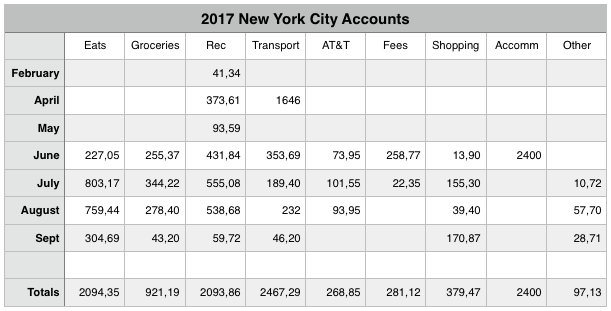
New York City – Day 1

~ So there we were, a plane load of passengers and crew on a United Airlines flight, flying in to New York’s John F. Kennedy airport, late on a Monday afternoon in March 2008.


With great interest and excitement, I looked out of my window (I always try and get a window seat), at the Long Island suburbs slipping quickly below the wings. My brief view of the New York skyline revealed the familiar look of lower Manhattan and a host of skyscrapers spearing into the sky as if they were trying to reach some distant planet.


As we flew in over Brooklyn my attention was caught by numerous structures that seemed to stand high over buildings and landscape alike. Looking more like giant four-legged pins, these proved to be a constant source of fascination throughout my New York stay. They were of course, water towers – structures that seem to be unique to the American landscape. Not that other countries don’t have water towers – they do. But surely not in the huge numbers that dot New York’s buildings and other parts of the American environment.


An article in Wikipedia notes that during the 1800s, the city required the installation of water towers on buildings higher than six stories to prevent the need for excessively high water pressures at lower elevations, which could burst municipal water pipes. Today, even modern buildings have these water towers perched high over already high structures.


A quick taxi ride delivered me to my accommodations for the next 28 days – the YMCA on Meserole Avenue, in the Brooklyn suburb of Greenpoint. After checking in, I immediately went back out to take a walk around the neighbourhood.


This is a ritual I always perform when I find myself in unfamiliar cities or locations. It gives me some idea of the ‘lay of the land’. I look for prominent landmarks (to help me find my way back to my room); the nearest bank or ATM; a local supermarket or deli where I can stock up on essential food items (water, fruit, snacks, etc); local cafés, fast food outlets or restaurants; the nearest subway station or bus stop; an internet café or public library with internet access; a laundry where I can wash clothes; and local bars and clubs which might offer live music or other entertainment.


But most of all, I try to get a feel for the neighbourhood ‘vibe’. Does it feel safe? Do the locals seem friendly? Do they look relaxed and happy? Are there lots of people hanging around on street corners looking like they have nothing to do? Will I have to walk through half a mile of dimly lit streets to reach the subway station? Or more importantly, if I return to my room at 2:00am in the morning, will I be safe? And so it goes.


To a certain extent, all this and more can be ascertained if you spend an hour or so carefully observing your surroundings. I am happy to say that I was delighted with my choice to use the Greenpoint YMCA as my New York base. I have written an extensive two part review of the Greenpoint ‘Y’, and my stay in the area already so I won’t repeat myself here (read Part One and Part Two).


My initial walk around Greenpoint revealed I had arrived in ‘little Poland’. Café’s, restaurants, hairdressers, tax agents, in fact retail outlets of all types and descriptions seemed to be targeted at the large Polish community that has made Greenpoint its home. Signs on several shop windows advertised positions vacant for Polish speaking shop assistants. A peek into one newsagent showed almost every publication to be in the Polish language. Not that any of this was a problem – I just hadn’t been expecting it.


I am always fascinated by the architecture of the cities I visit. Every country, and often individual cities within countries have their own distinctive architecture. The architecture of any town or city must surely be governed by the materials available to the inhabitants who build the homes and buildings that make up each urban centre. The amount of available land would also need to be taken into consideration. Given that most of New York city is built over a number of islands, making the best use of available land must have been a high priority.


Ignoring for now, the obvious architectural landmarks that are New York’s skyscrapers, what really caught my eye were the brownstones, row houses, and tenement buildings that the majority of New York residents call home. Many of these were built during a period of rapid expansion from 1870 to 1930. while many timber-framed buildings still stand, stone and brick became the city's building materials of choice after the construction of wood-frame houses was limited following the Great Fire of 1835.


Another distinctive feature I found fascinating were the fire escapes that adorn the façades of many older New York buildings. Again, thanks to Wikipedia we learn that “…the invention of these exterior steel staircases is widely credited to Anna Connelly who first registered a patent for a fire escape in the USA in 1887.”


Who knows just how many lives have been saved over the past 120 years by Connelly’s bright idea.


I was to learn much more about Greenpoint over the next four weeks, but as I sat down in a local café jet lagged and weary, and ordered something to eat, I was just happy to be in New York City, and looking forward to my first visit to Manhattan. But that’s a story for another day.


Thanks to Wikipedia for some of the historical information contained in this post.

Friday, October 9, 2009

Friday Photo #14: Storage Containers

Click image to view full size

I discovered these large storage containers gathering dust in the basement of an abandoned stone house on the Greek island of Ikaria during my extended stay there in 2008.

I have no idea how old they are, but they are almost certainly 60-70 years old if not even up to 100 years old. They were – and still are – traditionally used to store olive oil, or the whole olives themselves. They might also be used to store home made wine, potatoes, or other long lasting vegetables or grains, which would serve to keep the household in provisions throughout the long winters.


Today, modern containers made from plastic are substituting for these large clay pots, which can be a metre or more (3 feet) high. As durable as the plastic may be, it will never be as aesthetically pleasing to look at, nor will it last as long.

Photographer: Jim Lesses, Ikaria, May 2008

Thursday, October 8, 2009

Ferry Hopping Around Sydney Harbour

~ Have I told you about the day I spent ferry-hopping my way around Sydney Harbour? No? Well, then, this is as good a time as any to tell you about one of Sydney’s hidden gems – the Day Tripper transport pass.

The $17.00 Day Tripper Pass gives you unlimited transfers across the whole of Sydney’s trains, buses, and ferry services. During my Sydney stay I decided to purchase one and use it to ride as many of Sydney’s iconic ferries as I could. In the end I only managed to travel on four of eight ferry routes, but I thoroughly enjoyed every minute of my time on the Harbour.


My first ‘port of call’ was of course, Circular Quay, where I boarded the first available ferry for my adventures out and about on Sydney Harbour. As it happened, the first ferry I spotted was going to Manly, so I quickly boarded and found some free space up by the bow.


I should have guessed the Manly ferry would be one of the most popular operating out of Circular Quay, and indeed a good 80% of the passengers were tourists and visitors like myself.


As we cast off from the quay, the jockeying for prime photographic positions was well and truly underway. Those passengers on the right (or starboard) side of the ferry, concentrated their cameras on the Sydney Opera House, while those on the left/port side, aimed their ‘weapons’ at the Sydney Harbour Bridge. The best placed travellers at the bow of the ferry were of course, able to capture both landmarks, while those at the stern aimed their cameras at the slowly receding city skyline, before turning their attentions to both the Opera House and Harbour Bridge.


The 30 minute trip to Manly went smoothly enough, and as I disembarked at Manly Wharf, my intention was to spend another 30 minutes having a quick look around before reboarding the next ferry back to Circular Quay. Two hours later I finally forced myself back onto a ferry to complete that circuit!


Ah, Manly. Even in April the sunbathers were still to be seen stretching out on the sand soaking up as much warmth as the late autumn sun could offer.


Manly. The name says it all. Venice Beach it isn’t, but Manly Beach can still muster up a good showing of inline skaters, joggers, visitors, skateboarders, gawkers, dog walkers, swimmers, promenaders, tourists, surfers, poseurs, and the afore mentioned sunbathers.


While there, make sure you take the time to sample the fish-n-chips from one of the numerous outlets along the foreshore, or The Corso, that strangely named thoroughfare leading from Manly Wharf to the main beach.


The ferry to and from Circular Quay sails parallel to the ‘heads’ separating the north shore from the south. As we cruised past the entrance to Sydney Harbour – or if you prefer, the entrance to the Pacific Ocean – the ferry bucked and heaved in the rising swell. Tourists around me oo-ed and ah-ed as the sea spray hung in the air, and the ferry carved its way into calmer waters again for the remainder of the journey to Circular Quay.


At Circular Quay I quickly boarded the Neutral Bay ferry service. This service makes a number of stops along the North Shore, and includes Kirribilli, where the Australian Prime Minister has his Sydney lodgings (at the appropriately named Kirribilli House).


Back at the Quay my next cruise was on the Balmain/Woolwich ferry. Instead of doing the full circuit, I decided to jump off after several harbourside stops at Greenwich Point. From the landing site I had a clear view of the Sydney skyline, and as the afternoon sun began dipping in the west, I took photo after photo of a golden sunset reflecting off the glass and steel of the buildings in the CBD.


My final ride was on the longest of the eight major ferry routes servicing Sydney Harbour. This route, which runs up the Parramatta River to the suburb of Parramatta, is serviced by a RiverCat vessel – a large catamaran type craft designed to navigate the lower depths of the river, especially at the Parramatta wharf end.


By the time I boarded the RiverCat, the sun had all but disappeared below the horizon. For the next hour, I and my fellow passengers were treated to a spectacular evening cruise that took in Luna Park, Darling Harbour, Cockatoo Island, Olympic Park, and almost a dozen other harbourside stops. And best of all, I was able to stay on the craft and return by the same route – albeit in reverse order – and once again wallow in the luxury of Sydney Harbour at night.


In a previous entry (Circular Quay, Sydney) I wrote: “I never thought I’d say this, but I think the area around Circular Quay is as vibrant, exciting, and involving as any similar part of New York City (where I spent two months last year).”


Well, I never thought I’d say this either, but in terms of setting, Sydney Harbour beats Manhattan, hands down. Of course, New York has more skyscrapers, and taller ones than Sydney, but in this case size doesn’t matter.


What Sydney has is one of the most stunningly beautiful natural harbours in the world. Port Jackson (to give Sydney Harbour its official name) is 19 km long with an area of 55 square kilometres. If you were to walk around the perimeter of the harbour you would cover a distance of around 317 kilometres.


For my small investment of $17.00 I saw only a fraction of this vast expanse of water and the beautiful city that has grown up around it, but I loved every minute of it. If you have the time to do as I did, I urge you to spend as much time on the harbour as you can. I guarantee you, you won’t be sorry.


Image: Sydney Ferry, Narrabeen

Photographer: Jim Lesses

Blog Widget by LinkWithin