Saturday, May 27, 2017

Surfing The Web: Roller Coasters, Baby Elephants, Tips For The Travel Weary


A Shiny New Ride Above the Sand at the Jersey Shore
The repercussions of the shocking destruction wreaked by Hurricane Sandy late in 2012, is still being felt along the eastern seaboard of the United States, with some damaged infrastructure still waiting to be permanently fixed. Just in time for the coming summer season, one of these rebuilt projects sees the replacement to one of the Jersey Shore's most famous attractions. Nick Corasaniti takes up the story for the New York Times.
SEASIDE HEIGHTS, N.J. — It was one of the indelible images of the wrath of Hurricane Sandy: a famous Jersey Shore roller coaster reduced to a twisted, mangled wreck in the surf off Seaside Heights, its decades-old iron and steel slicing the coming waves.
It was removed months later, but the gash along the coast remained for years, the emptiness above the rehabilitated pier an ever-present reminder of the worst natural disaster to strike New Jersey in decades.
Now, perhaps quicker than some expected, there is a new coaster where the old one once stood. And this one is different. Gone are the classic dips and turns of the rickety old Jet Star, the thundering vibrations of its cars rippling through the boardwalk wood.
In its place is a shiny new ride that looks as if it was plucked from the fields in nearby Jackson, where the Six Flags Great Adventure theme park sprawls for acres. Called the Hydrus, it is a twisted green behemoth, featuring a steep inverted drop, a full loop and two more inversions. The coaster’s new tracks run eerily silent, the faint hums of the rail car often drowned out by the high-pitched squeals of riders.


Kenyans Work To Save Baby Elephants
Back in March, in a piece about ending the slaughter of elephants I wrote about the ongoing campaign to protect these magnificent creatures from poachers. The following article from the HuffPost continues the positive news about this vital fight.

“We take care of the elephants, and the elephants are taking care of us.” Jesselyn Cook, World News Reporter, HuffPost

Had the members of northern Kenya’s Samburu tribe encountered an injured or abandoned baby elephant a year ago, they likely would have left it to die. Today, with the support of the Reteti Elephant Sanctuary, locals are working to save endangered calves.
Photojournalist Ami Vitale traveled to the baby elephant orphanage to document community relations with the animals for National Geographic. Reteti opened in August as part of a network of community groups in the region working to foster sustainable development and wildlife conservation. Elephant keepers there try to rehabilitate wounded calves and reunite them with their herds, when possible.
Elephants are ecosystem “engineers,” Vitale notes. They feed on low brush and bulldoze small trees, which promotes the growth of grasses and attracts other grazing animals.
But ivory poachers have caused elephant numbers to dwindle, with the African elephant population plummeting by more than 110,000 over the past decade, according to the International Union for Conservation of Nature. At least 33,000 elephants are killed for their tusks annually.


Travel Fatigue: 10 Tips for Road-Weary Travelers
My go to website for the Solo Traveller which I thought might be useful for those travellers who enjoy the luxury of extended travel.
To travel alone for two or three weeks is one thing. But to travel alone for two or three (or five or ten) months is quite another. It takes a different attitude and a different pace. And even when you do it well, it can result in you becoming road-weary.
Travel fatigue is a kind of rattled feeling. It’s a need for stability and a wish for home. Fortunately, there are things other than returning home that you can do to feel good. 
Among the eleven suggestions:
  • Stay still: that is, settle into one place for a while.
  • Settle where you can speak the language: the rationale is that you will feel more relaxed if you are not constantly struggling with language. Of course, if you are trying to learn the language of the country you are visiting, then the best way to do that is to immerse yourself in the life of the country you are in and work on those language skills.
  • Repeat yourself: return to a city you’ve already visited and loved.

Thursday, May 25, 2017

Move, Breathe, Fly, Float...


To move, to breathe, to fly, to float,
to gain all while you give,
to roam the roads of lands remote,
to travel is to live.
~ Hans Christian Andersen

Wednesday, May 24, 2017

Ten Desert Island Films

If you had to spend a year on a desert island, and could only take 10 movies with you, what would they be? Here, in no particular order are ten of my favourite films (by genre), with brief explanations for why I chose them. 

Francis Ford Coppola's masterpiece. There as so many great moments in this movie. Everyone's favourite moment is when Robert Duvall's character, Col. Kilgore utters the famous, "I love the smell of napalm in the morning..." line. But my favourite line, also spoken by Duvall/Kilgore comes soon after that napalm line: "Someday this war's gonna end." There is so much regret in his voice when he says this, that you know Kilgore, and many people like him are going to miss the war, and the positions of power and influence it gives them.

I actually prefer the original version. The longer Redux version has lots of extra footage but much of it just gets in the way of the storytelling. While it was nice to see the much talked about French Plantation scene, and the Playboy Bunnies scene, I don't think they add a lot to the main story. In fact, I think the French Plantation scene actually makes the movie look dated when viewed today.

As for Marlon Brando's performance as Colonel Kurtz - I think it is great. It's perfectly fitting that this man Kurtz, who is slowly going crazy in his lair, deep in the Cambodian jungle, spends most of his time sitting in the dark brooding over his actions, while waiting to 'suffer the consequences' of these actions.

Favourite Scene: This movie is full of great scenes, but for sheer heart thumping excitement you can't go past Wagner's Ride of The Valkeryies as the choppers sweep in to attack the Vietnamese village early in the morning. I can never hear that music now, without thinking about that particular scene.

Other Contenders: Stanley Kubrick's Full Metal Jacket; and the brilliant German film about life on a German submarine during the Second World War, Das Boot (The Boat). If you are going to look for Das Boot online, do yourself a favour and find the original German language version, not the dubbed into English one.


Sci-Fi: Blade Runner
Why do I like this film so much? It is a combination of great acting, stunning sets and cinematography, and a story line with something real and meaningful to say. Ridley Scott's sci-fi noir masterpiece stars Harrison Ford, as the Blade Runner of the title, and Rutger Hauer, Sean Young, and Daryl Hannah as replicants (life-like robots), trying to find their maker before their working life runs out and they 'die'.

This is another movie I never get tired of re-watching. Of course, you should make sure you get the Directors Cut, which is probably the only version you can get on DVD anyway.

Favourite Scene: Batty/Rutger Hauer's final speech. "I've seen things you people wouldn't believe. Attack ships on fire off the shoulder of Orion. I watched C-beams glitter in the dark near the Tannhauser gate. All those moments will be lost in time, like tears in rain... Time to die..."

Other Contenders: Stanley Kubrick's 2001: A Space Odyssey, is an obvious choice. Less well known is another of my favourite sci-fi movies, Dark Star, a precursor of sorts to Ridley Scott's obvious contender, Alien.


Drama: Brazil
Terry Gilliam's classic movie of a not too distant dystopian future where a huge monolithic bureaucracy (which seems remarkably close to the vision George Orwell created in his book, 1984), controls every aspect of daily life. Staring Jonathon Price, Michael Palin, and Robert DeNiro, is Brazil just a bizarre dream? A terrifying nightmare? A figment of Jonathon Price's over active imagination?

Whatever it is - you may never view the comic genius of Michael Palin in the same way again. But that's already telling you too much if you haven't yet seen the movie, which I urge you to do - not once, but many times. In fact, you will need to see it multiple times to pick up on all the things you missed the first and subsequent times you watched it.

Like all of the films on this list, I never tire of watching this movie, but I have to be in a certain frame of mind before I do so. It's not the sort of film that leaves you with a good feeling - however brilliant it undoubtedly is.

Favourite Scene: I'm not sure if it's possible to have a favourite scene in this movie. It is at times bizarre, hilarious, bleak, terrifying, hallucinogenic, and much more besides. In deed, Sam Lowry's (that is, Jonathon Price's) first day in Information Retrieval is probably all of those adjectives and more, so I will select that as my favourite, although every scene is a winner.

Other Contenders: Louis Malle's Days of Heaven; Michael Cimino's Heaven's Gate.


I love musicals. I think this goes back to my childhood when I fell head over heels in love with Doris Day, after seeing her in the Western musical, Calamity Jane! In fact I was so besotted with her that my very first vinyl album (bought with the financial assistance of an older sister), was the soundtrack to that movie.

Little Shop Of Horrors is the musical version of the Roger Corman film of the same name which famously featured a cameo performance from a very young Jack Nicholson. This musical remake stars Rick Moranis, and Ellen Greene (who also starred in the original Broadway show). It also has cameo performances from Steve Martin, John Belushi, Bill Murray, and others.

I like it this movie so much I watch at least twice a year! Viewing it is guaranteed to brighten my day, and put me in a good mood if I'm feeling down, or put me in a super mood if I'm already feeling 'up' and looking to get really charged.

Favourite Scene: Bill Murray as the masochistic dental patient is an absolute scream, especially when pitted against Steve Martin as the sadistic dentist! Be warned. If you have a phobia about dentists, close your eyes and block your ears for the duration of this scene.

Other Contenders: The Rocky Horror Picture Show; and West Side Story.


The Coen Brothers, Joel and Ethan, could have been represented on this list several times, and in several genre's, but I've settled on this gangster epic because I love everything about this movie. The performances, the cinematography, the plotting, and especially John Turturro's "Look into your heart..." speech.

Favourite Scene: Have I mentioned John Turturro's gut wrenching "Look into your heart..." speech, as he is about to be shot and left to rot in a forest? Classic stuff, this.

Other Contenders: Martin Scorsese's Goodfellas; the other Coen Brothers classic, Blood Simple; Coppola's The Godfather; and one of my all time favourites, Sergio Leone's Once Upon a Time in America.

Which is a good lead in to Sergio Leone's western masterpiece...


Sergio Leone was the director that made Clint Eastwood famous after he cast Eastwood in his trilogy of 'Dollars' films: A Fistful of Dollars; A Few Dollars More; and The Good, The Bad, and The Ugly. But as good as these films are, I think Leone was still working out what he really wanted to say about the American West and the people who populated it. For me, all this comes together perfectly in his epic masterpiece, Once Upon a Time in The West.

Right from the opening credits, you know you are in for an experience like no other. If you've seen the movie, you know what I'm talking about. If you haven't, it's almost impossible to adequately describe the first ten minutes of the film as three gunmen wait for a train at an isolated railway station.

Then there are the film's four main actors; Charles Bronson, Claudia Cardinale, Henry Fonda, and Jason Robards. What a great line-up of stars. Henry Fonda playing 'against type' as Frank, the cold blooded killer is a revelation. All this, and Ennio Morricone's brilliant score make it one of my all time favourite movies.

In fact, I've watched this film more times than I can remember, and every time I watch it, I discover something new in it. If you haven't seen the movie, you are the poorer for it.

Favourite Scene: So many scenes - so many favourites. However, my most favourite scene is when Jill/Claudia Cardinale first gets off the train, and begins her walk along the station platform, into the station office (where she pauses briefly to talk to one of the staff), then out through the front door of the station, and out onto the dusty street of the western town she has just arrived in. All this shot in one long gorgeous take, set to Ennio Morricone's wonderful theme written especially for her character (all the main characters have their own musical theme). I never get tired of watching this scene. Never.

Other Contenders: Clint Eastwood's Unforgiven; Sam Peckinpah's The Wild Bunch; and Sergio Leone's already mentioned, The Good, The Bad, and The Ugly.


There are people around who can quote great tracts of dialogue verbatim from this film. I can't, but there is much to like about this movie and the motley crew of errant knights roaming the countryside in search of the Holy Grail.

Flying cows; the black knight and the black plague; witches and damsels in distress; Trojan rabbits; Knights who say, "Ni"; all this and much more, mixed together in a strange brew that only the Monty Python team would dare to concoct. If you don't find this film hilarious, you need a funny bone transplant.

Favourite Scene: Scene 4: Constitutional Peasants: wherein Michael Palin's peasant mud collector swaps some great lines with Graham Chapman's, King Arthur.
Palin: "Supreme executive power, derives from a mandate from the masses, not from some farcical aquatic ceremony!"
King Arthur: "Be quiet!"
Palin: "You can't expect to wield supreme executive power just cos some watery tart threw a sword at you."
Arthur: "Shut... up!"
Palin: "I mean, if I went round saying I was an emperor just because some moistened bint had lobbed a scimitar at me, they'd put me away."
Arthur, (grabbing hold of Palin): "Shut up! Will you shut up?"
Palin: "Ah, now we see the violence inherent in the system."
Other Contenders: Dirty Rotten Scoundrels, starring Steve Martin and Michael Cain is a delight; and the Monty Python team's other classic, The Life of Brian.


This would almost qualify as a musical itself if there were a few more songs in it being performed by the actors. There is so much to like about this film, I'm almost embarrassed to go on about it in case I look like I'm gushing!

Julia Roberts, Rupert Everett, Dermot Mulroney, and Cameron Diaz bring so much to this movie that it's hard to imagine anyone else taking their places in the film.

I love the way Julia Robert's character is frustrated at every turn by her own attempts to stop the impending wedding of her 'best friend', Dermot Mulroney to Cameron Diaz. I love how Cameron Diaz's hopelessly out of tune attempt at karaoke is turned into a triumph (it's so bad, it's good). Then there is Rupert Everett's restaurant scene when he starts to sing Dione Warwick's, Say a Little Pray For You, and all the other customers in the restaurant join in. Then there is the...

Well you get the picture - or if you haven't already got it - you should. One of my all time favourites.

Favourite Scene: Apart from those mentioned above, I love the way the film ends with the phone call between Rupert Everett and Julia Roberts, and their final dance together. What a great way to end the movie.

Other Contenders: yet another Coen Brothers classic, Raising Arizona, and of course,that perennial favourite, The Princess Bride.


The newest addition to this list, Martin Scorsese's three and a half hour documentary exploring Bob Dylan's formative years in New York City is a revelation in every sense of the word. Containing lots of previously unseen footage of the young Dylan, including many great performances and interviews old and new, this doco is a must have for all Dylan aficionados.

Viewed together with D. A. Pennebaker's 1965 documentary, Don't Look Back, both films paint an extraordinary portrait of the artist as a young man as he reshapes the musical landscape around him. Watching this film you get a sense of the enormous pressure Dylan was under to shoulder the burden of 'spokesman of a generation'. A role he didn't ask for or want, and which he is still trying to fight against.

Even today, 40 years after turning his back on folk music, I know people who still haven't forgiven him for 'selling out' the folk protest movement, and carving out his own unique musical path. Thank God, he did ignore all the carping and criticisms; the constant booing from unthinking fans, and the stupid inane questioning of media reps to follow his Muse wherever it chose to lead him.

Favourite Scene: I was blown away by the power of some of the early concert performances we get to see in this film, especially Only a Pawn in Their Game. Dylan sings with such focus, such power and conviction, that it is easy to see why he garnered so much attention and interest in those early years in New York.

Other Contenders: Martin Scorsese's The Last Waltz; and Woodstock (the original movie), for which incredibly, Scorsese also filmed some concert footage.


Drama: The Mission
Robert DeNiro and Jeremy Irons both star in this stunning movie. The fact that the film also has a wonderful score composed by Ennio Morricone only adds to the pleasure one gets from viewing this beautifully photographed film.

Made when the concept of Liberation Theology was gaining much prominence among the established western churches in the late 1970s and early 1980s (especially in the Catholic church), the film focuses on a small group of 18th Century Spanish Jesuits - played by Irons and DeNiro - who go into the South American wilderness to build a mission in the hope of converting the Indians of the region. When Spain sells the colony to Portugal, they are forced to defend all they have built against Portugese slave traders.

The ending will not leave you feeling good, but thankfully the makers of the film stayed true to the story, and resisted the typical happy Hollywood ending.

Favourite Scene: It's almost impossible not to be knocked out by the scene where Robert DeNiro, as the character Mendoza, a former slave trader, does penance for his past sins by dragging a huge and heavy bundle of swords, armor, helmet, and clothing to the top of a high valley as water spumes and pours down around him every step of his weary way.

- o0o -

This has been a real challenge, selecting ten of my favourite movies. As the alternative titles listed under Other Contenders indicate, for very movie chosen I could easily substitute several others in each category. Still, it was an interesting exercise. How about you, dear reader—what are your 10 most popular movies?

Tuesday, May 23, 2017

TED on Tuesday: Ben Saunders - Trek to The North Pole or Stay at Home?


Ben Saunders is one of those all too rare individuals who has taken life ‘by the horns’, to use a well-known phrase, and pushed his mind, body and spirit to what the rest of us would consider to be the limits of human endurance. To Ben Saunders, his monumental treks to both the North and South Poles were about testing himself and his ability to live his life to its fullest.

The two TED talks below complement each other well. The first talk, Why did I ski to the North Pole?, was filmed in 2005, the year following this successful venture. In the second TED talk, Why bother leaving the house?, recorded in 2012, Saunders explains the reasons for embarking on his epic Arctic and Antarctic treks.

There are lessons in both these talks for everyone, and maybe the most important one of all is that we are all capable of far more than we have ever allowed ourselves to image. It is certainly true that the vast majority of the human race uses just a fraction of the huge potential inherent in each of us—and yes, I am including myself in this assessment.

Ben Saunders urges audiences to consider carefully how to spend the “tiny amount of time we each have on this planet.” And while we may never aspire to push ourselves to the same limits that Saunders has tested his own abilities, I hope these talks will inspire you (as they have me), to challenge yourself to do, and be more than you ever thought you could possibly be.


Ben Saunders is an explorer of limits, whether it's how far a human can be pushed physically and psychologically, or how technology works hundreds of miles from civilization, his message is one of inspiration, empowerment and boundless potential.
“Humbly framed as the ambitious undertakings of an ardent athlete, [Ben's treks offer] visceral first-hand accounts of just how much things are changing in the Arctic -- the 'barometer of global climate change.'” — Worldchanging.com


Monday, May 22, 2017

36 Hours In Havana, Cuba

Screen shot from the New York Times video

Another in the New York Times series 36 Hours In… This time we’re visiting Havana, Cuba. Damien Cave writes:
Havana is no longer frozen in time, at least not completely. With Cuba’s guarded openness to private enterprise grabbing hold, classic American cars and salsa singers now share the cityscape with new and inventive offerings in food, culture, night life and hospitality. No other city in Latin America, or perhaps the world, can claim to be having just the kind of moment that Havana is experiencing now after so many decades gasping for change.
For visitors, the capital is a mash-up of past and present, freedom and restriction. It’s a city of architectural decay, but also creativity, where artists have turned a defunct cooking-oil factory into a performance space, bar and music venue that on any given night makes Brooklyn look as cool as a suburban Ikea. It’s a city where finding ingredients for a stellar menu requires feats of Promethean ingenuity; where opera is subversive, and kitschy too; where the Internet is just arriving, fully formed and censored; and where young Cubans without money are fleeing, while those with connections and ideas await great success.
Officially, some limits for Americans remain in place. Despite restored relations with Cuba, tourism is still banned by the embargo. But for those who reach Havana under the 12 categories of legal travel, or without permission, and for the rest of the world, the city is ready to entertain and confound.

- o0o -

Saturday, May 20, 2017

Telling The Story of Slavery in America

The magnificent oaks of Oak Alley. Image: Jim Lesses

During my 2012 American trip, I spent five nights in New Orleans and among the numerous activities I engaged in during my stay in the Crescent City, were tours that included the Laura, and Oak Alley plantations. Being the political animal that I am, I was very much aware of what seemed to be the ‘whitewashing’ of history associated with both these beautifully preserved sites, and the part they must have played in supporting one of the worst stains in human history—the institution and maintenance of organised slavery on a massive scale.

It is not as if the history of slavery was completely ignored at these former plantations, and others like them, but more that the legacy of slavery was left to the imagination of the visitor rather than bringing it front and centre. The beautifully maintained plantation homes, and the well manicured lawns and gardens, might leave visitors with the impression that life on a pre-American Civil War plantation wasn’t all that unpleasant. In fact, the Oak Alley Plantation can be hired for weddings, corporate events, and overnight stays—“A tranquil retreat in the heart of Plantation Country”—proclaims one caption to a series of images on the site. While life may have been very pleasant for the plantation owners, it was far from pleasant for the slaves.

John J. Cummings III; Screen shot from the New Yorker video.

Since my 2012 trip, I am delighted to see that at least one former property—the Whitney Plantation—has now been set up as the first memorial of its type in America. The New Yorker magazine, under the byline of Kalim Armstrong ran an item and video in February 2016, Telling The Story of Slavery from which the following quote is taken:
John Cummings, a lawyer who founded the [Whitney Plantation] museum, spent sixteen years planning and over eight million dollars of his own money to restore this site, which honors the memory of those who were enslaved on plantations and whose labor helped build this country. The Whitney Plantation is not a place designed to make people feel guilt, or to make people feel shame. It is a site of memory, a place that that exists to further the necessary dialogue about race in America.
The Whitney Plantation was founded in 1752, and is located in Louisiana along the historic River Road, which winds down the Mississippi toward New Orleans. Here is the New Yorker video:


It wasn’t hard to find other videos detailing various aspects of slavery and the plantation system online, and the following 28-minute video is from what appears to be a made-for-television series called Weekends With Whitney. Independently produced by Whitney Vann, the program focuses on the story behind the Whitney Plantation and supplements the New Yorker video very nicely. Note: This show has three advertising breaks built into the video, but thankfully they are short and almost unobtrusive.


If You Go
The Whitney Plantation
5099, Highway 18, Wallace, Louisiana.
Open 9:30am to 4:30pm every day except Tuesday
(The museum is also closed on Thanksgiving, Christmas Eve and Christmas Day, New Years Day, Mardi Gras, Easter Sunday, and July 4th.)
Note: the website states that, “There are no self guided tours at The Whitney Plantation.” And further that, “The only way to visit The Whitney Plantation is through a guided tour.” Tours are given every hour between 10:00am and 3:00pm.
Prices range from $10.00 to $22.00 (see website for full schedule)

Friday, May 19, 2017

Wednesday, May 17, 2017

At The Movies: The Eagle Huntress

Photo: Asher Svidensky

This spellbinding documentary follows Aisholpan, a 13-year-old nomadic Mongolian girl who is fighting to become the first female eagle hunter in twelve generations of her Kazakh family. Through breathtaking aerial cinematography and intimate verite footage, the film captures her personal journey while also addressing universal themes like female empowerment, the natural world, coming of age and the onset of modernity.

The above synopsis comes from the Internet Movie Database entry for this film. 

Immediately after watching The Eagle Huntress, I had my doubts as to whether the film was an authentic documentary, or merely a reconstruction of events that had already taken place earlier in the life Aisholpan Nurgaiv, a young girl who dreamed of becoming a hunter and trainer of eagles, a role that has traditionally been reserved for boys and men on the chilly, windswept steppes (large areas of flat, unforested grasslands in South East Europe or Siberia), in a remote corner of Mongolia. However, after a couple of hours searching for, and watching interviews with Otto Bell, the director, I am more than satisfied that the events depicted in the film are captured pretty much as they happened.

Otto had seen a series of photographs on the BBC website by the Israeli photographer, Asher Svidensky which immediately sparked his interest in Aisholpan’s life. He was also quick to see the cinematic possibilities of telling her story and bringing this to a wider world, and I’m very happy he did because the film is definitely worth seeing. 

The remote setting and natural scenery (the towering Altai mountain ranges of Western Mongolia, and steppes stretching off to the far horizons) are simply stunning. The rituals and routines of daily life, and the work of herding, milking, and hunting seem hard—but not so hard as to make one grateful they don’t live in that environment. Scenes of family life are generally presented as tough, but they also come across as romantic and wholesome. Here is a family that works hard and plays hard. Their material possessions are reduced to the basic and essential. We don’t see a television anywhere, although we do see several portable radios. There are also motorbikes, vehicles of various types, a portable solar panel or two—and horses. Lots of horses.

Oh, and of course, eagles. A lot of eagles as well.

I was very impressed with Aisholpan’s ability to work with and relate to the young Golden Eagle she caught with the help of her father, Rys. These magnificent creatures are not like the pigeons and doves that flap gently about our city streets. These are large, heavy birds that weigh up to seven kilograms (15 pounds), and grow to have 7-8 foot wingspans. The trainers and hunters must be able to bear the weight of these birds as they sweep in and land on their outstretched arms with a force that I suspect would knock pasty-faced city boys like myself flying off their feet. But Aisholpan handles these flying missiles with a wide smile and nary a quiver. That she was able to do this at just 13 years of age is an even greater achievement in my opinion. Clearly, they are brought up tough on the Mongolian steppes.

The eagle hunters capture the young birds just before they are able to leave their aeries, and according to tradition, will release them back into the wild after a number of years of captivity. In fact, the film begins with a scene in which Rys, Aisholpan’s father is depicted as doing exactly this.

There are scenes in this film that may distress some viewers. Hollywood movies involving animals usually have a sentence buried in the end titles that say something to the effect that,’no animals were harmed during the making of this film.’ The Eagle Huntress carries no such note. After all, the eagles are trained specifically to hunt. Rabbits mostly, but also foxes and other small game. They also have the ability to hunt animals as large as wolves, which I have to say amazes me no end.

Here's the official movie trailer for the film

I went looking on YouTube for more clips about the film and about Aisholpan in particular, and was pleased to find several very good videos that included interviews with her and her father. These took place during their visit to the Sundance Film Festival where the film was receiving its premier screening. The Eagle Huntress is beautifully shot, and Aisholpan, her father, and her family are all natural actors who are proud to share their culture and traditions with the wider world.

The Eagle Huntress Featurette - Documentary (2016)
- o0o -
If you have a chance to see the film at your local cinema, or streaming on Netflix or another online streaming service, do so. You won’t be disappointed.


Updated: May 17, 2017
Just after uploading this post, I went looking for the original 2014 BBC News story that featured Asher Svidensky’s photographs of the young eagle huntress, which you can read here

I also happened upon a more recent article about the film that mirrored my opening paragraph doubts about the authenticity of the film with regard to it being a true documentary. This article, Is the Eagle Huntress really a documentary?, also on the BBC News website raises genuine questions about this issue, but again as I indicated above, I am still “…satisfied that the events depicted in the film are captured pretty much as they happened.”

And finally, both articles above carry discrepancies with regard to the spelling of Kazakh names. In the first article, the young girls name is spelt Ashol-pan, not Aisholpan, though the second version is used in the second of these articles. Also the IMDB gives her father’s name as Rys, while the second article on the BBC News site gives his name as Agalai. For now I have chosen to use the same spelling as that used on the IMDB site.

Tuesday, May 16, 2017

TED on Tuesday: The World of Caves

Screen shot from the Jill Heinerth TED video

Cave diver Jill Heinerth explores the hidden underground waterways coursing through our planet. Working with biologists, climatologists and archaeologists, Heinerth unravels the mysteries of the life-forms that inhabit some of the earth's most remote places and helps researchers unlock the history of climate change. In this short talk, take a dive below the waves and explore the wonders of inner space.

More people have walked on the moon than have been to some of the places that Jill's exploration has taken her right here on the earth. From the most dangerous technical dives deep inside underwater caves, to searching for never-before-seen ecosystems inside giant Antarctic icebergs, to the lawless desert border area between Egypt and Libya while a civil war raged around her, Jill's curiosity and passion about our watery planet is the driving force in her life.


- o0o -

Screen shot from the Eddy Cartaya TED video

A ranger at Deschutes National Forest in Oregon, Eddy Cartaya not only solves cave crimes — he also explores the ever-changing system of caves within Mount Hood's Sandy Glacier.

Much of Eddy Cartaya's life takes place in caves. A ranger at Deschutes National Forest in Oregon, in charge of law enforcement and investigations, he solves crimes that happen in caves. This can range from investigating the theft of lava formations that date back 6,000 years to tracking down a group of people who covered over ancient cave art with spray paint. 

Cartaya and his climbing partner, Brent McGregor, also explore the frozen, icy caves created in the Sandy Glacier as it slowly slides down Oregon's Mount Hood. In 2011, the pair identified and explored three caves which they named Snow Dragon, Pure Imagination and Frozen Minotaur. Together, the caves create 7,000 feet of passageway through the glacier. Experts think this may be the longest glacial cave system in the United States outside of Alaska.


Monday, May 15, 2017

Surfing The Web: Kissing Fanny, Ten U.S. Hikes, 32 Toronto Tips, Adelaide History


Say, What? The Art of Kissing Fanny!
One of my favourite blogs is the very eclectic Messy Nessy Chic. Vanessa, or ’Nessy’ as she refers to herself, is a young expat English woman now living in Paris. I don’t know how she does it, but her blog has one of the most interesting collections of stories and posts that I have ever encountered in my many years of trawling across the Internet. Every visit reveals a new gem that is sure to enlighten, amuse and entertain the reader.

A recent post; The Art of Kissing Fanny has to be read to be believed. It just goes to prove that there is a story behind everything—no matter how arcane or obscure.
There’s a curious expression used in Provence by pĆ©tanque players. “Embrasser Fanny” or to “kiss Fanny”, is a small recompense for making a fool of oneself to put it simply. But where does this mischievous phrase originate from? Fanny was a waitress at a local cafĆ© in the Savoie region or Lyon– no one seems to agree. Watching the men playing pĆ©tanque (or boules) one day, she declared that she would allow any man who lost 13-0 in pĆ©tanque, to kiss her on the cheek.

Mount Katahdin. Photo: Alamy

Ten of The Best US Hiking Trails
Once, dear reader, I fantasized about walking across America, a ridiculous idea if ever I had one, if only because I was well into my late-50s when I was taken with the fantasy. Not that others haven't done exactly that before or since my imagination got the better of me. It's just that the cold hard reality of my aging bones have told me loud and clear, that "It ain't gonna happen, buddy!" Not in this lifetime, anyway. Still, I can dream, can't I? And this is as good a place as any to keep feeding that dream.

From a rocky wonderland with views of Las Vegas to the green ridges of the Appalachians, readers of the British newspaper, The Guardian share their favourite great walks. Among those recommended are walks through the New England mountains, Vermont’s 272 mile Long Trail, New Mexico’s Pecos Wilderness trails, and the Continental Divide Trail which runs through five states from New Mexico to Montana.


Toronto skyline

The Solo Traveler: 32 Tips for an Affordable Toronto
Among the many email newsletter I subscribe to (the basis of a blog entry themselves), is the very fine and comprehensive Solo Traveler site. The Canadian writer, Janis Waugh writes in her bio that she “…became a widow and empty-nester at about the same time.” In 2009, she began Solo Traveler and the site has quickly become one of the most popular sites for information and tips specifically aimed at people who travel solo—of which I am one. Of course, the information on the site is just as useful for couples, and families.

Completely at random, I have chosen to highlight the article, Affordable Toronto: 32 Free and Low-Cost Tips from her site, but seriously, take some time to browse through the hundreds of excellent feature articles awaiting you. There is surely something for everyone here.


Source: State Library of SA Searcy Collection RG 280/1/7/418

Then and Now: Eleven Rare Historic Photos of Adelaide
Since I was born and raised—and still live—in Adelaide, Australia, I thought these rare images from local history may be of interest. Besides, May is History Month in South Australia, so that is as good a reason as any to include this article. Among the images is the one I chose to illustrate this section, which shows two nurses, or “ministering angels” from approximately the year 1913 caring for two babies at the Adelaide Children’s Hospital (now renamed The Women's and Children’s Hospital).

I selected this image for a specific reason—namely, because I spent 14 years of my working life at the Children’s Hospital (as it was still called then), and despite the pain and suffering I saw there, those 14 years were among the most rewarding years of my life. As an aside, I have been fortunate enough to have only been admitted to hospital once in my 68 years—at the very same Adelaide Children’s Hospital—when I was admitted, at the age of five, to have my tonsils removed, an incident I still remember to this day.


P.S. I should also stress that apart from the 'pain and suffering', I also witnessed many moments that bordered on the miraculous, many of which were carried out by new generations of 'ministering angels', and medical personnel.

Sunday, May 14, 2017

Happy Mother's Day


I have already written about the Mother's Day celebrations I attended on the Greek island of Ikaria during my visit there over the summer of 2014 in Mother's Day Greek Island Style

I wrote then:
"...what I especially love about these island celebrations and traditions, is that they are embraced equally by the very young as well as by the very old. No one shouts at the kids to sit down and keep quiet, or to stay out of the way of the performers. The whole square seems as if it is being rearranging constantly by an invisible hand that manages to keep dancers, children, organisers and visitors out of each other's way, as the evening progresses."
My parents emigrated to Australia from Ikaria just before the Second World War, and as much as I love New York City, Ikaria is my true second home. I had planned to return to the island this year, but another much bigger island (Manhattan) enticed me back for what may be my last visit. In the meantime, Ikaria is not going anywhere, and all being well I will return to Greece and the island in 2018.

For Mother's Day, 2017, I thought it appropriate to repost the video of the Mother's Day celebrations one more time--so clear away the tables and chairs and get dancing!


Saturday, May 13, 2017

Mona Lisa Crush


Why do we do it? Is it because of the clever marketing? The fact that the portrait is the work of Leonardo da Vinci, one of the greatest artists of all time? The enigmatic smile, perhaps? Or because if you are visiting the Louvre in Paris, the visit would be incomplete without going to see the Portrait of Lisa Gherardini, wife of Francesco del Giocondo (to give the portrait its full title)?

I read somewhere that it has been estimated that most visitors lining up to see the Mona Lisa spend as little as 15 seconds in front of the painting. Fifteen seconds! I don’t know if there is any truth to that claim, but certainly virtually no-one has time to linger more than a few minutes before her. The crush of bodies, the raised cameras, the ridiculous selfie poses struck by gawking teenagers and adults who should know better, and the constant attention and wariness of security guards, all combine to make any visit to the Mona Lisa one of the least enjoyable experiences of any trip to the Louvre.

Besides, the painting is hardly on the grand size. At just 77 cm by 53 cm (30 inches by 21 inches), Leonardo da Vinci’s masterwork is dwarfed by just about every other work of art inside the Louvre. This also makes the possibility of examining the painting closely a pretty much hopeless task—not that you can get that close to it anyway.

When I visited at the beginning of winter in December 2010, the lines to room 6, on the first floor of the Denon wing were thankfully short and the crowds almost thin. I hate to think what the queues must be like during July and August, the peak European tourist season.

If you really must go to see the Mona Lisa during your Parisian holiday, don’t be surprised if you come away from the experience disappointed by the whole circus surrounding this one painting. Instead, make up for any disappointment you feel by immersing yourself in the hundreds (in fact, thousands) of other fabulous art works to be seen and enjoyed, up close and at leisure in the same room and throughout the museum.

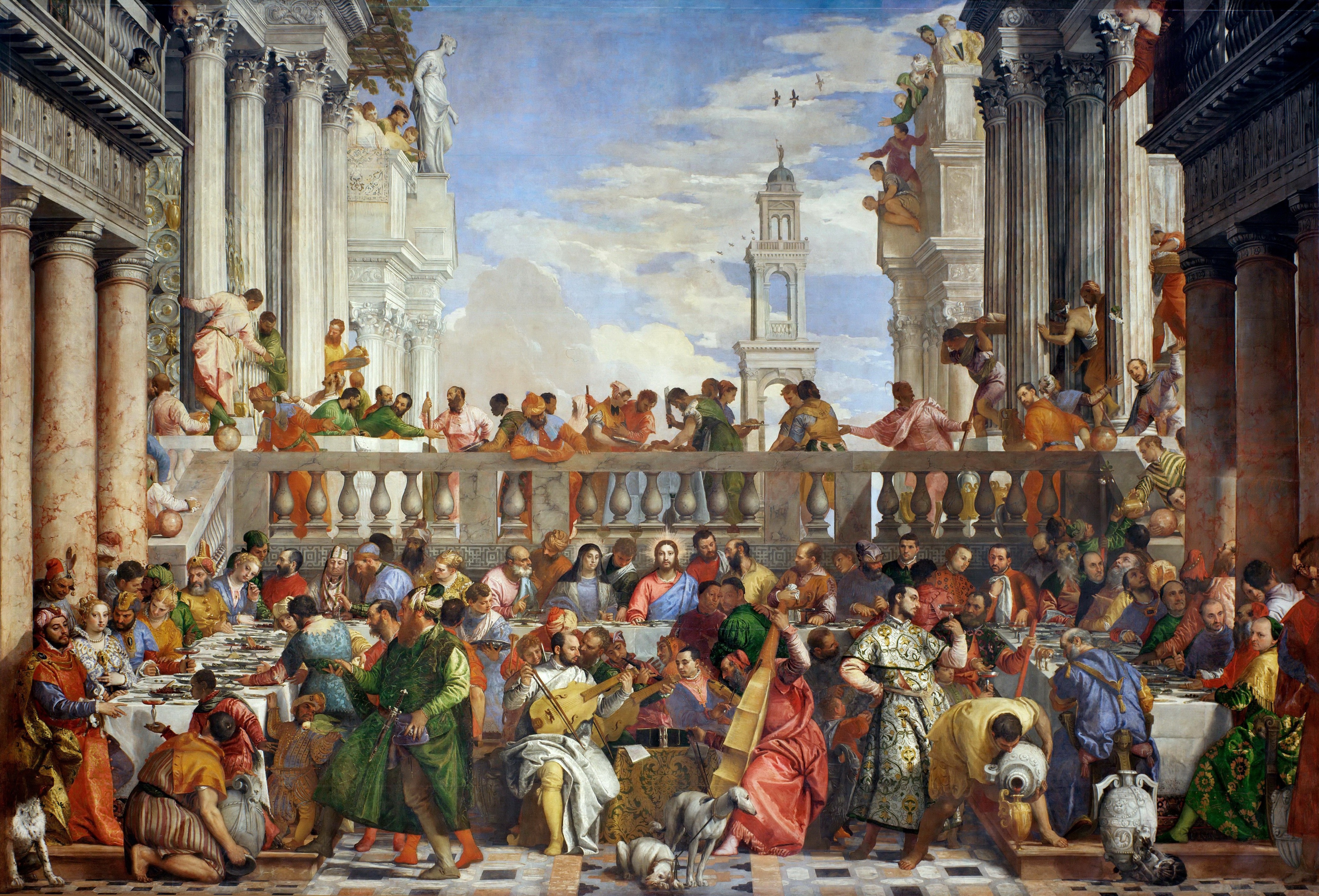
Once you have had your glimpse of SeƱora Gherardini, turn around and stand in awe, as I did, before a work of such monumental proportions that it is impossible not to be impressed by the size and scope of the work. This is Paolo Veronese’s, ‘The Wedding Feast at Cana’.


Where the Mona Lisa is 77cm x 53cm (30in x 21in), Veronese’s ‘Wedding Feast…’ is a massive 6.77 metres by 9.94 metres—or 22.2 feet high, and 32.6 feet long!

Click this link for full screen view of Wedding Feast at Cana... and make sure you use your mouse to zoom in for close up look at this masterpiece. 

Now here is a painting you can get lost in. Here is a work that demands the viewer stop, contemplate, examine, and marvel at Veronese’s vision. This is the work of a true master. Every wedding guest and attendant seems to have their own story to tell, with each either caught mid-sentence or in the act of performing some task (pouring wine, playing instruments, or serving guests). Even the gawkers hanging on to the columns of nearby building or crowding the balconies are filled with life and movement.


For my money, any number of other paintings at the Louvre are far more worthy of closer attention than Leonardo's Mona Lisa, and the placement of Veronese's monumental work on the wall directly opposite her, feels like a deliberate attempt by that institution's curators to show the thousands of daily visitors that there are other masterpieces in the building that are arguably more deserving of their attention.
Related Posts Plugin for WordPress, Blogger...