Sunday, May 14, 2017

Happy Mother's Day


I have already written about the Mother's Day celebrations I attended on the Greek island of Ikaria during my visit there over the summer of 2014 in Mother's Day Greek Island Style

I wrote then:
"...what I especially love about these island celebrations and traditions, is that they are embraced equally by the very young as well as by the very old. No one shouts at the kids to sit down and keep quiet, or to stay out of the way of the performers. The whole square seems as if it is being rearranging constantly by an invisible hand that manages to keep dancers, children, organisers and visitors out of each other's way, as the evening progresses."
My parents emigrated to Australia from Ikaria just before the Second World War, and as much as I love New York City, Ikaria is my true second home. I had planned to return to the island this year, but another much bigger island (Manhattan) enticed me back for what may be my last visit. In the meantime, Ikaria is not going anywhere, and all being well I will return to Greece and the island in 2018.

For Mother's Day, 2017, I thought it appropriate to repost the video of the Mother's Day celebrations one more time--so clear away the tables and chairs and get dancing!


Saturday, May 13, 2017

Mona Lisa Crush


Why do we do it? Is it because of the clever marketing? The fact that the portrait is the work of Leonardo da Vinci, one of the greatest artists of all time? The enigmatic smile, perhaps? Or because if you are visiting the Louvre in Paris, the visit would be incomplete without going to see the Portrait of Lisa Gherardini, wife of Francesco del Giocondo (to give the portrait its full title)?

I read somewhere that it has been estimated that most visitors lining up to see the Mona Lisa spend as little as 15 seconds in front of the painting. Fifteen seconds! I don’t know if there is any truth to that claim, but certainly virtually no-one has time to linger more than a few minutes before her. The crush of bodies, the raised cameras, the ridiculous selfie poses struck by gawking teenagers and adults who should know better, and the constant attention and wariness of security guards, all combine to make any visit to the Mona Lisa one of the least enjoyable experiences of any trip to the Louvre.

Besides, the painting is hardly on the grand size. At just 77 cm by 53 cm (30 inches by 21 inches), Leonardo da Vinci’s masterwork is dwarfed by just about every other work of art inside the Louvre. This also makes the possibility of examining the painting closely a pretty much hopeless task—not that you can get that close to it anyway.

When I visited at the beginning of winter in December 2010, the lines to room 6, on the first floor of the Denon wing were thankfully short and the crowds almost thin. I hate to think what the queues must be like during July and August, the peak European tourist season.

If you really must go to see the Mona Lisa during your Parisian holiday, don’t be surprised if you come away from the experience disappointed by the whole circus surrounding this one painting. Instead, make up for any disappointment you feel by immersing yourself in the hundreds (in fact, thousands) of other fabulous art works to be seen and enjoyed, up close and at leisure in the same room and throughout the museum.

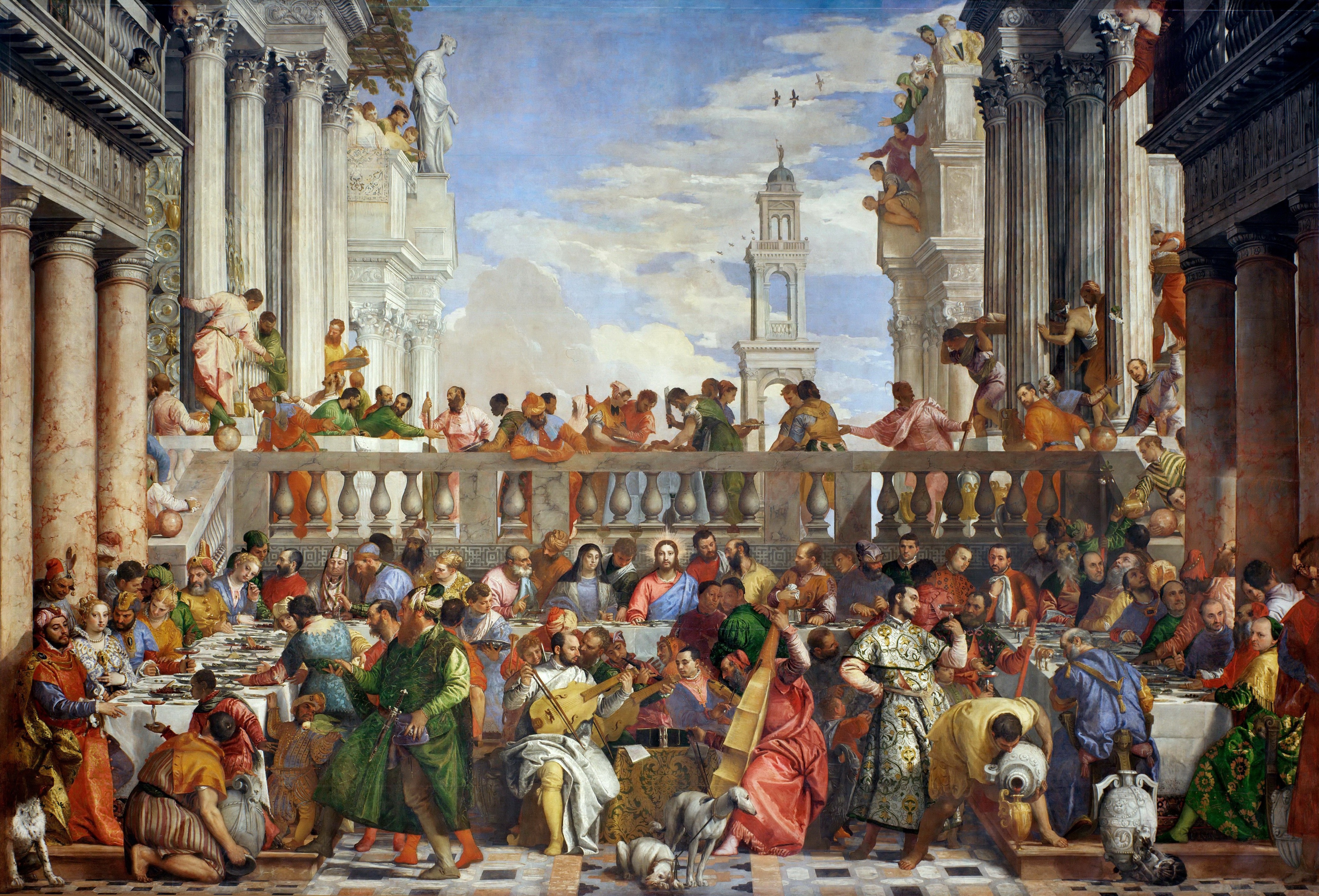
Once you have had your glimpse of SeƱora Gherardini, turn around and stand in awe, as I did, before a work of such monumental proportions that it is impossible not to be impressed by the size and scope of the work. This is Paolo Veronese’s, ‘The Wedding Feast at Cana’.


Where the Mona Lisa is 77cm x 53cm (30in x 21in), Veronese’s ‘Wedding Feast…’ is a massive 6.77 metres by 9.94 metres—or 22.2 feet high, and 32.6 feet long!

Click this link for full screen view of Wedding Feast at Cana... and make sure you use your mouse to zoom in for close up look at this masterpiece. 

Now here is a painting you can get lost in. Here is a work that demands the viewer stop, contemplate, examine, and marvel at Veronese’s vision. This is the work of a true master. Every wedding guest and attendant seems to have their own story to tell, with each either caught mid-sentence or in the act of performing some task (pouring wine, playing instruments, or serving guests). Even the gawkers hanging on to the columns of nearby building or crowding the balconies are filled with life and movement.


For my money, any number of other paintings at the Louvre are far more worthy of closer attention than Leonardo's Mona Lisa, and the placement of Veronese's monumental work on the wall directly opposite her, feels like a deliberate attempt by that institution's curators to show the thousands of daily visitors that there are other masterpieces in the building that are arguably more deserving of their attention.

Friday, May 12, 2017

My Current Reading List

I suspect that I am like most inveterate readers, in that I often have more than one book underway at any particular time. I don’t know why this is. What is it about some books that keep you glued to the page, reading late into the night, while others manage to keep you engaged for the first few chapters before your interest begins to tail off to the point you finally give up (though not completely), and you turn to that second or third book on your tottering pile of reading material stacked on the dresser next to your bed?

I also suspect that the comment about ‘not completely’ giving up is also true for many readers. Some half-read books sit next to my bed or on the bookcase in the lounge room for weeks and months, waiting patiently for my return. These books may not have the ability to keep me up late at night, but neither do they fall completely off my reading list. There is just enough of interest in the story they are telling to keep me on the hook, waiting for the right moment to take up the tale again.

As for my current reading list—the three books I have been juggling this month are Jimmy Breslin’s Table Money, J.D. Vance’s Hillbilly Elegy, and Joseph Michael Reynolds’ Dead Ends, a book detailing—as the subtitle states—The Pursuit, Conviction, and Execution of Serial Killer Aileen Wuornos.

I started out the month with Table Money, by Jimmy Breslin. I have mentioned Breslin in other posts, noting that to date I have bought eight of his books. Of these eight I have read four titles, and Table Money was going to be my fifth Breslin book.

Table Money recounts the story of several generations of ‘sandhogs’, a name adopted by the tunnel workers who toiled beneath the streets of New York City carving out the subterranean tunnels that brought fresh water to the great metropolis. All the Breslin trademarks are here—hard working, and even harder drinking working class immigrants; corrupt politicians and union leaders; brutal bosses and their meaner henchmen who stand over the immigrant workers ensuring they remain unorganised and un-unionised; and long-suffering wives and their under-educated children.

Despite the glowing praise for the book (“…a serious literary novel, a superior work of fiction.”—The New York Times; “…a heavyweight saga in an era of welterweights,”—Los Angeles Times; and “…easily Breslin’s best novel.”—Library Journal), I found the going tough and put the book aside around a quarter of the way through.

Last week I bought J.D. Vance’s much acclaimed memoir, Hillbilly Elegy. Subtitled, A Memoir of a Family and Culture in Crisis—the ‘culture in crisis’ being that of white working-class Americans. James David Vance grew up in the Rust Belt city of Middletown, Ohio, and the Appalachian town of Jackson, Kentucky. His grandparents were “dirt poor and in love,” and moved north from Kentucky to Ohio to escape the endemic poverty that surrounded them in Jackson. 

They raised a middle-class family, which eventually included the author who went on to graduate from Yale Law School, and who has now written a timely book that may provide some of the answers to the many questions being asked about the rise of the alt-right in America and the unexpected rise of Donald Trump to the Presidency of the United States.

Again, despite my interest in America and American politics, and despite the fact that I was settling into the book quite comfortably, I somehow managed to distract myself by working on entries for this blog, and by the other general reading that I do. And then, wouldn’t you know it, before I could get back to Hillbilly Elegy, along came Aileen Wournos.

Wournos was one of those atypical phenomena that thankfully come along all too rarely, that is, a female serial killer. I had seen and been greatly moved by the 2002 film, Monster, in which Charlize Theron portrayed Wounos with a stunning Academy Award winning performance that would earn her an Oscar for Best Actress—so when I saw the eBook being offered at a discount for just USD$1.99, I jumped at the chance to buy it. 

Joseph Michael Reynolds was a journalist for Reuters at the time Aileen Wuornos was embarking on her late-1980s killing spree, and it was Reynolds who first broke the story in the national media. First published in 1992, Dead Ends traces the story of Wuornos, a person who might have fitted very well into J.D. Vance’s book as just another of the millions of down on their luck working Joe’s with few prospects, and even fewer options for escaping the hole they had found themselves in. Holes, it should be said, that they mostly dig themselves.

Here at last is a book that has managed to keep me up at night. As I write, I am down to the final few chapters, and with less than an hour or so of reading remaining, I will finish the book later today. I will then make my way back to Hillbilly Elegy, and before the month is out, I will take another look at Jimmy Breslin’s novel. Having said that, there are dozens of other books straining for my attention, and any one of those might win out over Table Money or for that matter Hillbilly Elegy.

Tuesday, May 9, 2017

TED on Tuesday: Paul Nicklen's Animal Tales From Antarctica

Screen shot only. Watch the full video below.


Paul Nicklen: Animal tales from icy wonderlands
Diving under the Antarctic ice to get close to the much-feared leopard seal, photographer Paul Nicklen found an extraordinary new friend. Share his hilarious, passionate stories of the polar wonderlands, illustrated by glorious images of the animals who live on and under the ice.


Monday, May 8, 2017

The Weekly Web

Image courtesy of the American Museum of Natural History

My round-up of the best of my online ramblings over the past week begins with the Shamans of SiberiaThe American Museum of Natural History in New York City has a comprehensive program of events and activities that run throughout the year. I have visited the museum twice and hope to visit again during my trip to New York over the coming summer. I signed up for their email newsletters several years ago, and each issue always makes me wish I lived much closer to the museum than my current address some ten thousand miles away. 

The latest newsletter had several links to items of interest, and I thought this would be a good time to mention an ongoing program called Shelf Life, which presents a series of short videos highlighting the Natural History museum’s ongoing conservation programs. In Shamans of Siberia in 360, we get to look at an expedition to Siberia that took place from 1897 to 1902.
The Jesup North Pacific Expedition (1897–1902) was conceived and directed by Franz Boas, the founder of American anthropology. The expedition aimed to investigate the links between the people and cultures of the Pacific Northwest Coast of North America and the eastern Coast of Siberia. Boas was also concerned about documenting cultures that he and many other anthropologists feared would soon be lost to colonialism and acculturation.
The video below is one of the new style of documents that presents footage in 360 degrees. Make sure you enlarge the video to full screen, and then use your cursor to manipulate the film to see everything around the camera.


The ‘Protector’ and ‘Fitzjames’ (in the background), c.1885 at Largs Bay. State Library of South Australia

South Australia’s “hell afloat”
InDaily is an online publication out of Adelaide, Australia—my home town. The site has been publishing a regular series, Time and Place, which focusses specifically on important South Australian events and achievements. The entry: South Australia’s “hell afloat”, provided information about an aspect of the state’s early history I knew nothing about, and I suspect that few others did—or still do.
Between 1880 and 1891 the hulk Fitzjames, colloquially known as ‘hell afloat’, served as a Reformatory for over 100 boys aged from eight to 16 years of age. The first 35 of these were transferred from the Boys’ Reformatory at Magill on 5 March 1880. Some had been sentenced for having committed serious crimes, while others had been found guilty of petty theft, or deemed uncontrollable or neglected.
More Time and Place stories here…

Sumida River, Tokyo.

36 Hours in East Tokyo
One of the most daunting cities for foreign visitors, Tokyo is a manic, hyperactive assault on the senses. But steady your focus and you’ll notice that a distinct strand of traditional elements also weaves through the Japanese capital. Even without leaving Eastern Tokyo, here defined as the area east of the Imperial Palace, a visitor can experience the enormous breadth of what this mesmerizing metropolis has to offer. From boutiques blooming in abandoned spaces to new ramen shops taking root amid glittering high-rises, Eastern Tokyo promises — now more than ever — to leave even experienced travelers wide-eyed with wonder.


National Portrait Gallery, London
50 Free Things to Do in London, England
Actually, this Guardian newspaper series dating from 2012, originally ran to 200 free things to do in London. I have included links to Parts 3 & 4 of the series, but Part 2 seems to have disappeared. Even the Guardian website does not seem to know where it is. Be aware that some of the details provided in the articles may have changed in the five years since first publication.

Part 2: I will update this post when (and if) I find part two of this series

Photo by Dan Winters / Courtesy NASA / JPL-Caltech / MSSS

Interstellar Travel — Don’t Hold Your Breath
This story by Burkhard Bilger (The Martian Chroniclers), published in the New Yorker in April, 2013, is a ‘long read’, but is worth the time taken to read in full. Mars of course, is the next planet humans have long set their eyes and hearts on to send a manned mission to. The fascination with the red planet is the belief that some form of life (however basic and primitive), exists on some primal level. 
The search for life on Mars is now in its sixth decade. Forty spacecraft have been sent there, and not one has found a single fossil or living thing. The closer we look, the more hostile the planet seems: parched and frozen in every season, its atmosphere inert and murderously thin, its surface scoured by solar winds. By the time Earth took its first breath three billion years ago, geologists now believe, Mars had been suffocating for a billion years. The air had thinned and rivers evaporated; dust storms swept up and ice caps seized what was left of the water. The Great Desiccation Event, as it’s sometimes called, is even more of a mystery than the Great Oxygenation on Earth. We know only this: one planet lived and the other died. One turned green, the other red.
If humans ever do make it to Mars, and survive long enough to reproduce and populate that planet, it will be long after I have moved on to whatever other dimension awaits—if any. Personally, I can’t see the point of exporting the full gamut of human foibles and failings to another planet—unless the first hundred crews are manned by politicians, and that is never going to happen. If we can’t get this world sorted out, what makes anyone think we can do so on a planet as harsh and barren as Mars? But that’s just the cynic in me talking. I’d love to read your comments on this topic. In the meantime, you can read the full article here…
Related Posts Plugin for WordPress, Blogger...