Montezuma Castle
National Monument is located in Arizona, approximately 140 km (87 mi) north of
Phoenix, and about 80 km (50 mi) south of Flagstaff. I wrote more about my
visit to the monument here, so for my Friday Photos feature today I thought I would post some more images
from that amazing site.
Click images to view full sized
...
The Native Community
Numerous information panels provide
interesting historical and cultural facts about the cliff-dwellings, and the
surrounding landscape.
Mysterious Departures
The five-story stone and mortar dwellings
contained 20 rooms and once housed about 50 people.
View of brickwork and roof supports
Neither part of the monument's name is
correct. More like a prehistoric high rise apartment complex than a castle, the
site was abandoned by the Sinagua 100 years before Montezuma was born.
MontezumaCastleNational Monument
No access to the ruins themselves has been
allowed since 1950 due to extensive damage of the dwelling, and the unstable
nature of the limestone cliff face.
Diorama of cliff dwellings
This architecturally correct diorama gives
visitors an idea of the internal layout of cliff-dwellings.
Diorama of cliff dwellings
MontezumaCastleNational Monument was one of four original sites designated National Monuments by
President Theodore Roosevelt in December 1906. The Monument was listed on the
National Register of Historic Places in October, 1966.
A wall of glass greets the faithful to the Adelaide Apple Store
How many years has it been since Apple Inc
began setting up their Apple Stores around the world? According to Wikipedia: “On May 19, 2001, Apple opened the
first official Apple Retail Stores in Virginia and California. As of November
2012, Apple maintains 394 retail stores in fourteen countries as well as the
online Apple Store and iTunes Store.”
To answer my own question then, it has been
12 years since Apple opened their first store. And make that figure 395 retail
stores and counting. I mention this because a few weeks ago (May 25, 2013) Apple Inc opened its first Adelaide store in
the heart of the city in Rundle Mall. I wish the venture every success, but I
can’t help wondering if it may be arriving a little too late. I mean, it is not
as if Apple products are impossible to find here. Not when pretty much every
telecoms shop, Harvey Norman, JB-HiFi, and Dick Smith store sell Apple products.
And let’s not forget every major department store, and a host of other outlets.
Oh, and of course, there are the stores that specialize exclusively in Apple
products such as Next Byte and others.
And just to show how my timing is off―as
usual―the Adelaide Apple store opened less than a month after I traded in my
old iPhone 3GS for the latest Galaxy S4. Oh, well. Better late than never, I
guess. Good luck Apple. It is good to see you here, at last.
Australian speakers seem to be few
and far between on TED, so I was particularly pleased to watch this talk by the
former cross-country skier, Janine Shepherd.
Janine was aiming for an Olympic
medal―until she was hit by a truck during a training bike ride through the Blue
Mountains (60-90 minutes from Sydney). Shephard’s doctors did not expect her to
survive, and when she did, they warned her that she would never walk again. But
she not only learned to walk again―she learned to fly.
Janine focused intently for years on healing both her broken
body and crushed morale. A turning point came watching small planes flying
overhead. She decided: “If I can’t walk, I’ll fly.” While still in a full body
cast, Janine was lifted into an aircraft for her first flight. Within a year
she had her private pilot’s license. Later, she earned her commercial pilots
license and instructor’s rating. Janine recently served on the board of
Australia’s Civil Aviation Safety Authority (CASA) and became its youngest―and
only―female director.
Despite being a walking paraplegic, Janine Shepherd is also
a pilot and aerobatics instructor, as well as a powerful motivational speaker
and author. In this TED talk she shares her inspirational story about the human
potential for recovery. Her message: you are not your body, and giving up old
dreams can allow new ones to soar.
Today, Janine is the patron of the Australasian Spinal
Research Trust and is committed to helping find a cure for spinal cord injury
in the near future. In the meantime, she seeks to inspire those coping with
physical disability. She is the author of five books, including Never
Tell Me Never. And while doctors told her after her accident that she would
never have children, she now is a mother of three.
This 19 minute TED talk was first posted in November 2012.
“It [doesn't matter] what you look like, where you come
from, or what you do for a living. All that matters is that we continue to fan
the flame of humanity by living our lives as the ultimate creative expression
of who we really are.” ~ Janine Shepherd
TIM HAHNE is not only the founder of StereoScreen, but also a multi-talented visual artist who loves to
combine style and content with a very unique pictorial language. Tim started
his professional career in 1994, and has mainly been working as a director, but
also shoots, cuts, writes and composes music.
His film “24 HOURS in 19500 FRAMES” about the
24 Hour Nürburgring car race was an international success in 2010. Following that, the
BBC Top Gear program gave him the nickname “Car Telly Guru.” However, today’s
Armchair Travel video seems to be the short film that helped propel him into
the limelight after it was first posted to Vimeo in January 2010. Since then, The Beat Of New York has become a benchmark for modern
editing, mixed with contemporary sound design. Since its début Tim’s Vimeo site
has attracted millions of visitors, with this video itself gathering more than
600,000 views.
About The Beat of New York, Tim writes thatThomas
Noesner, the Director of Photography for StereoScreen, was in New York for a
Mercedes shoot. Right after the job, he took his camera and strolled through
the bustling streets of New York City. Tim adds, “While screening the pictures
of a drummer in the tube station, I had the idea of creating a remix of the
recorded drum sequence to use it as a soundtrack for the film. That’s when our
sound designer Toussaint came into play. We simply composed a track around the
drum beat of this guy. Watch and listen to the beat of New York!”
Want to see more? Last year, Tim co-directed the most
watched commercial in U.S. television history―the 2012 Superbowl ad for
Cadillac, which you can see here on YouTube. And make sure you visit Tim’s Vimeo page to see more of his excellent work.
Updated April 2016. Please note, this review refers to the former Hotel Brunswick in Lancaster, Pennsylvania, and in no way reflects or refers to the new Hotel Lancaster which today occupies the same building. At the end of this review I wrote, "... the current owners/managers must pay more attention to details, and push staff to provide a better, friendlier service - and they need to do it soon, or the hotel may continue its decline beyond the point of no return."
That 'point of no return' occurred in late 2013, when the hotel was closed down and taken over by new owners who have refurbished the building and rebadged it as the Hotel Lancaster. The transformation from the old rundown hotel into an updated and renamed hotel seems to have given the building a completely new 'lease of life', so much so that the reviews on TripAdvisor and other sites are today overwhelmingly positive, whereas once they were almost all negative. I was tempted to delete this post, but have decided to keep it for historical purposes.
- o0o -
The Hotel Brunswick in Lancaster, Pennsylvania promotes itself as
“A full service hotel with a three-star rating to accommodate all your needs
while travelling. We boast 221 spacious rooms and over 12,000 sq. feet of
meeting and banquet space for conventions and family gatherings.”
I like to make a point of being as honest and as positive as
possible with my reviews, but quite frankly I had to work hard to be positive
reviewing the Brunswick. The hotel website is full of beautifully presented
images that do not always reflect what I saw during my five night stay during
August 2012. In fact, on initially viewing the website I thought I was looking
at a completely different hotel.
An image on the hotel website shows a group of uniformed,
smiling staff who look like they are bursting with energy and enthusiasm, and
who want nothing more than to please hotel guests. I suspect this is a stock
photo image, or at best reflects much better days for the hotel. I saw no
uniformed staff during my stay, and while the few staff I did see carried out
their duties well enough, reception staff came across as mostly bored and
indifferent. However, my stay was not a disaster by any means, and I even
extended my initial three night stay by an extra two nights.
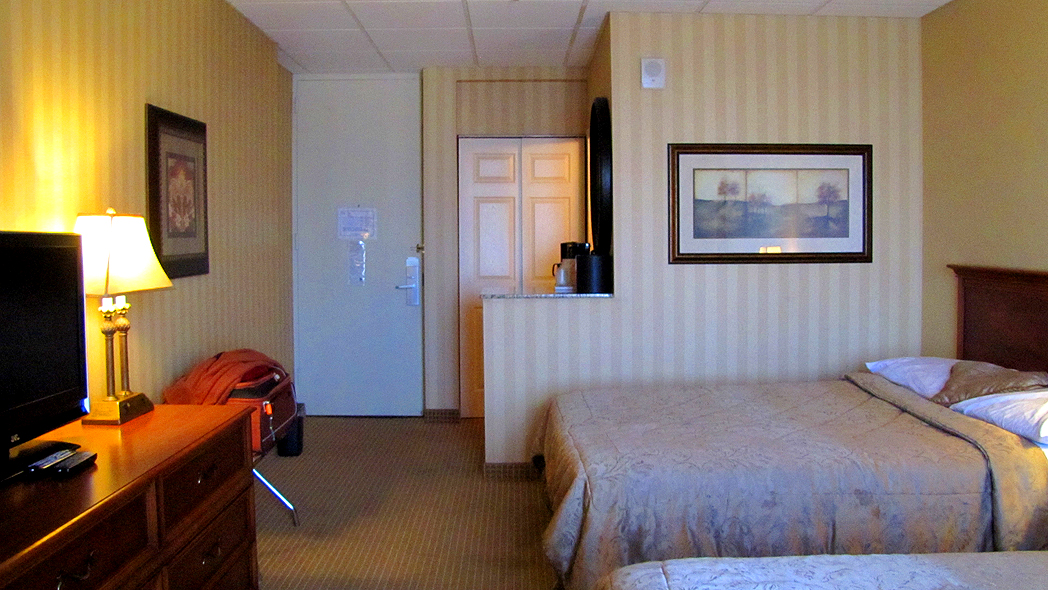
Room 912 bathroom had plenty of towels, mini shampoo, and hair dryer, etc
LOCATION: The Hotel Brunswick is located in the heart of
historic downtown Lancaster. Within walking distance of the hotel are many
restaurants, the city’s famous Central Market, Fulton Opera House and numerous
shops and art galleries. The hotel is also directly opposite the local bus
station which is perfect for travellers (like myself) who don't have their own
transport. Note: the Greyhound/Amtrak terminal is about 3/4 of a mile away at
the end of North Queen Street. For those visitors with their own vehicles, a
privately run parking garage is located right next to the Hotel Brunswick.
Separate fees apply when using this facility.
Room 912 general view
FACILITIES: Room 912 had everything most travellers would
expect to find in a typical hotel room and while I have no complaints about the
size of the room or its amenities, it was immediately obvious on entering
(judging by the bits of paper and other detritus on the floor), that the carpet
had not been vacuumed for what seemed like several days.
Other facilities listed on the hotel website include:
Free Wireless Internet service [which worked fine for my
purposes]
Cable TV and Showtime Channels [umm, can’t remember much
about these]
Voice Mail [if it was available, I never used it]
Coffee Maker, Ironing Board/Iron, and Hair Dryer [yes]
Individual Climate Control [yes, if they mean the ability to
adjust the air-con yourself. In fact, the air-con unit in my room was so
efficient that I had to turn the temperature up to warm the room. And this was
during August.]
BREAKFAST: Breakfast was passable (two cereals, bread for
toast, frozen waffles, mini-muffins, coffee, apple and orange juice, etc.), but
the service was very poor. Sometimes there were not enough plates, and at other
times, no napkins, or the coffee had run out. To cap it all off, no one
appeared responsible for cleaning tables after they had been vacated, which
often meant tables were smeared with jelly and butter, or covered with food crumbs
of one type or other.
Large comfortable queen size beds
GENERAL IMPRESSIONS: According to the ‘History’ section of the hotel’s website, “The
property operated under the “Hotel Brunswick” name until June of 2001 when it
acquired the “Ramada” flag and was named the “Ramada Inn Brunswick Conference
Center.” In February of 2005 the hotel was purchased out of bankruptcy
[my emphasis] by a California based company and the “Ramada Flag” was removed.
The hotel owners decided to keep the historic name of “HOTEL BRUNSWICK.”
Clearly, the hotel has seen better times, and even though it
apparently underwent some renovations a couple of years ago, it looks like it
has never quite recovered from the financial crisis that hit in 2010. It is
possible that renovations are still taking place at the hotel, albeit very
slowly, which might account for the very divergent reviews for the Brunswick
that can be found on TripAdvisor and other websites. The website advertises an
on-site restaurant but it was not operating during my stay, and I would venture
to say that the restaurant has not operated there for quite some time, although
the dining area was being used as the breakfast space.
Room 912, general view
I checked the hotel website while writing this entry. Under
the ‘Dining’ tab, the site states clearly that, "Our restaurant &
lounge are temporarily closed.” However, under the ‘Guest Rooms’ section of the
website, I found this: “The Hotel Brunswick offers an on-site restaurant and
versatile meeting rooms.” I can’t vouch for the meeting rooms, but I am
prepared to guess that the restaurant and lounge are still closed. It seems
little has changed in that respect in the ten months since my stay.
Despite everything I have written, the Brunswick was not the
dump some reviewers seem to think it is. Yes, the escalators leading to the
reception area were not working while I was there (and still appear to be out
of order), however the lifts were and still are operational.
The view from room 912 overlooking Lancaster Square
The excellent location and the great price make the
Brunswick a perfect place from which to explore the city of Lancaster and the
surrounding Amish country. However, the current owners/managers must pay more
attention to details, and push staff to provide a better, friendlier service -
and they need to do it soon, or the hotel may continue its decline beyond the
point of no return.
Here is a short video I put together from footage recorded just after my arrival in room 912:
HOTEL BRUNSWICK, LANCASTER, PA | My Rating: **1/2
151, North Queen Street, Lancaster, PA. Ph: (717) 397-4801
The Morning Star, Venus, hovers above a rising sun
My photographs today, feature a selection of
images taken during the early morning hours, either before the sun had risen
above the horizon, or soon after. In the image above, you can see what is
popularly known as the ‘morning star’, although the planet’s official name is
of course, Venus (also known as the ‘evening star’).
Early morning countryside. Mr Fox is out there somewhere.
Early morning country field somewhere along
Australia’s Mallee Highway (Route B12), not far from the Victoria country town,
Ouyen. I remember watching as a fox slowly loped across this open field, while
presumably on its way back to its den after a night out foraging for food. I
had pulled into a parking bay along the highway the night before where I slept
in the back of my station wagon.
The Mulwala Bridge linking Victoria and New South Wales
Early morning at Lake Mulwala, where the twin
towns of Yarrawonga (in Victoria), and Mulwala (in New South Wales) are joined
together by the Mulwala Bridge, seen here soon after dawn. The name,
Yarrawonga, is thought to be derived from an Aboriginal word meaning ‘place
where the wonga pigeon rested’. Mulwala derives its name from an aboriginal
word for 'rain'.
Early morning fog haze over Sydney
The early morning sun is rising through a haze
of fog in the image seen above. This, and the photo below was taken during a
visit to Sydney in 2009. In the image below, the sun has risen higher and is
burning away the morning mist to promise a beautiful day out and about on
Sydney Harbor.
Early morning Sydney skyline
...
Someone to watch over me. My early morning 'angel'.
And finally, the early morning sun throws my shadow 50 feet just before continuing my 2009 road trip from Adelaide to Sydney.
“Look at the dog chasing the man,” said the
boy, who seemed to be around seven or eight years of age.
“What are you talking about?” asked his
mother in obvious confusion.
“There,” said the boy, “see, there’s a dog
chasing a man?”
It was late on a Friday evening in
mid-September, when I, and a group of 20-30 international and American
visitors, gathered close to the edge of Grand Canyon’s south rim to watch as a
perfect autumn day drew to a close, and long shadows began to rise and stretch
across canyon walls away to the north.
The young boy pointed off into the evening
haze, and dozens of curious visitors followed the direction of his outstretched
hand to look for the ‘dog chasing the man’.
Eventually, even the oldest pair of eyes
watched in wonder as the two shadows seen in the image above slowly grew,
stretched and changed shape as the sun settled lower in the west.
I don’t know if the child’s parents had
ever told the lad the story of The Boy Who Cried, Wolf, but memories of
that old folk tale come to mind each time I look at this image, and I remember the
boy who taught me once again, the simple pleasures of looking at the world
through the eyes of a child.
During my 2012 visit to the United States, I spent five nights in
Flagstaff, Arizona, which I used as my base while I explored some of the
surrounding country. During my stay, one of the locations I happened upon―as I
headed somewhat randomly, south―was the Montezuma Castle National Monument, a
short distance off Interstate 17. Phoenix is approximately 140 km (87 mi) south
of the monument, and Flagstaff, is about 80 km (50 mi) north.
I had never heard of the monument before my visit, nor
therefore, had I seen images of the site. To say I was awestruck by the size
and scale of what turns out to be some of the best preserved cliff-dwellings in
the American Southwest, is an understatement.
The cliff-dwellings at Montezuma Castle were built and used
by the Pre-Columbian Sinagua people around 700 AD. The Sinagua were northern
cousins of the Hohokam, and the site was occupied from approximately 1125 to
1400 AD, with peak occupation thought to be around 1300 AD. By the way, when
European Americans discovered the cliff-dwellings in the 1860s, they named them
for the Mexican Aztec emperor, Montezuma II, due to mistaken belief that the
emperor had been connected to their construction. In fact, neither part of the
monument's name is correct. The site was abandoned by the Sinagua 100 years
before Montezuma was born, and the dwellings were not a castle. The building
was more like a prehistoric high rise apartment complex.
Exactly why the Sinagua abandoned the cliff-dwellings is not
known, but warfare, drought, and clashes with the newly arrived Yavapai people
have been suggested. The five-story stone and mortar dwellings contain 20 rooms
and once housed about 50 people. Nearby are the remnants of Tuzigoot (Apache for
“Crooked Water”), a Singuan Village built on the summit of a ridge. Tuzigoot
was two stories high, with 77 ground floor rooms that were accessible via
ladders through roof openings. Unfortunately, little of this site has remained.
Montezuma Castle information panel
Due to its isolated location, only about 350,000 tourists
visit the site each year. Access to the ruins themselves has not been allowed
since 1950 due to extensive damage of the dwelling, and the unstable nature of
the limestone cliff face. However, there is a paved trail that leads from the
visitor centre and skirts the base of the cliff containing the ruins, from
which excellent views of the dwellings can be seen. In addition, numerous
information panels (like the one seen at right) provide
interesting historical and cultural facts about the cliff-dwellings, and the
surrounding landscape.
The dwellings and the surrounding area were declared a U.S.
National Monument on December 8, 1906 as a result of the American Antiquities
Act, signed earlier in June of the same year. It was one of the four original
sites designated National Monuments by President Theodore Roosevelt. The
National Monument was listed on the National Register of Historic Places on
October 15, 1966.
If you are visiting Montezuma Castle, allow time to visit
Montezuma Well several miles away. The well is a limestone sink created by the
collapse of a large underground cavern, which is fed by permanent springs.
There are also ruins located here from large pueblos to one-room houses.
What You Need To Know
> Operating Hours & Seasons
Open Daily: 8:00 AM-7:00 PM in summer, and 8 AM-5 PM in
winter.
Closed on Christmas Day.
Phone: (928) 567-3322
Model depicting internal layout of cliff-dwellings
Montezuma Castle Entrance Fees
Adults (16 and over): $5.00 (good for seven days)
Children (under 16): FREE. Entrance fees for Montezuma Castle are collected inside the
park Visitor Center during normal business hours.
Passes are available at a discounted rate of $8.00 for both
Montezuma Castle and Tuzigoot National Monuments.
Philippe Petit is a French high-wire
artist who gained fame for his high-wire walk between the Twin Towers of the
World Trade Center in New York City, on 7 August 1974. Petit, who was born in
France, discovered magic and juggling at an early age, and at 16, he took his
first steps on the wire.
"Within one year," he told a reporter, "I
taught myself to do all the things you could do on a wire. I learned the
backward somersault, the front somersault, the unicycle, the bicycle, the chair
on the wire, jumping through hoops. But I thought, 'What is the big deal here?
It looks almost ugly.' So I started to discard those tricks and to reinvent my
art."
World Trade Center walk
On August 7, 1974,
Petit stepped onto a wire strung between the Twin Towers. Balancing 110 stories
in the air, Petit played on the tightrope for 40 minutes to the wonder and
amazement of the people watching on the ground. Petit was arrested as he left
the wire, but as the police cuffed him, he had a huge grin across his face—for
he had achieved a feat everyone, including himself at times, had thought
impossible.
“The impossible — we
are told — cannot be achieved,” Petit tells the TED blog in a Q&A about his
new eBook. “To overcome the ‘impossible’ we need to use our wits and be
fearless.”
The story of Petit’s walk was brilliantly told in the
documentary film, Man On Wire, by UK
director James Marsh. Petit has told the story in his own words, in his book To
Reach The Clouds, also republished as Man on Wire.
In this TED talk, Philippe Petit recalls the walk, talks about finding your passion, and makes
the case for confronting your fears and attempting the ‘impossible’.
Today, Petit shares his time between New York City where he
is an artist in residence at the Cathedral of Saint John the Divine, and a home
in the Catskills.
If you are unfamiliar
with Philippe Petit and his walk between the Twin Towers of the World Trade
Center, this YouTube video includes a number of images of Philippe taken during
the event.
More Information
Philippe Petit on Wikipedia...
[http://en.wikipedia.org/wiki/Philippe_Petit]
Image courtesy of Peter Kvalvikfjellet [http://www.kvalvik.no]
The Atlantic Ocean Road is an 8.3-kilometer (5.2 mi) long
section of County Road 64 which runs through an archipelago in Eide and Averøy
in Møre og Romsdal, Norway.
The road traverses an unsheltered part of the
Norwegian Sea, connecting the island of Averøy with the mainland and
Romsdalshalvøya peninsula. The road is built on several small islands and
skerries, which are connected by a number of causeways, viaducts and eight
bridges—the most prominent being Storseisundet Bridge.
The route was originally proposed as a railway line in the
early 20th century, but this was ultimately abandoned. Serious planning of the
road started in the 1970s, and construction started on 1 August 1983. During
construction, the area was hit by twelve hurricanes, but despite the hazards
involved in completing the project, the road was opened in July 1989.
Today, the Atlantic Ocean Road is preserved as a cultural
heritage site and is classified as a National Tourist Route. For reasons that
will become clear as you watch the video below, the road is a popular site to
film automotive commercials, and it has been declared the world's best road
trip. There are four rest areas along the road from which stunning views of the
surrounding landscape (or should that be seascape?) can be viewed.
The video below was filmed by Heine Schjølberg, who lives in Kristiansund, Norway, a
city and municipality with a direct connection to the Atlantic Ocean Road.
Schjølberg states on his YouTube page that the video was shot with a GoProHero 2 and a Sony XDCAM EX1 camera. He goes on to say
that the footage was recorded the day after Cyclone Patrick (renamed Dagmar
by the Norwegian Weather Service) hit the area on Christmas Day, 2011.
~ The Memorial Day Weekend is considered the official start of
summer in America, and I wish I was there to see the summer in. Since I’m not,
I thought I might at least point lucky visitors and locals to a few of my
favorite New York-centric websites and events.
Over the past 50 years, more than five million people have
enjoyed free productions of plays by William Shakespeare at the Delacorte
Theater in Central Park. This year The Comedy of Errors is the Public
Theater’s choice for their free annual Shakespeare In The Park production. The
play kicks off Tuesday, May 28 and runs through until Sunday, June 30, 2013.
All shows begin at 8:30 PM., and there is no intermission during the 90
minute performance.
If you want to join the audience, you are advised to line up
early on the day of performance.
Free tickets are distributed on each performance day from
12:00 PM (midday) via the free lines at the Delacorte Theater in Central Park.
Tickets are for the daily performance only. You can not line up to get tickets
for the following day, or for an upcoming performance.
Once The Comedy of Errors finishes its run it will be
followed by Love's Labour's Lost, A New Musical, which is of course, a
musical adaptation of Shakespeare’s Love's Labour's Lost. This
production will run from July 23 - August 18, 2013.
I have written about this website before here… This is my ‘go to’ site for cheap tickets to a whole range of events in New
York City and beyond. Via Goldstar you can find tickets (many at half their box
office price) to numerous theatre productions and major sporting events, as
well as walking tours, harbor cruises and much more. The great thing about
Goldstar is that discount tickets are available for similar events in more than
30 other cities across the United States.
SummerStage is another annual arts and music program of New
York’s, City Parks Foundation. It schedules a host of free events throughout
the summer months, and 2013 will be no exception. As in previous years, the
artists chosen for the 2013 program represent a wide range of genres and
cultures, and perform in outdoor settings accessible to people of all ages and
backgrounds. I was lucky to see one of my favourite performers, the late Gil Scott-Heron performing as part of the 2010 SummerStage concert series, and I am very
grateful to the City Parks Foundation for giving me that opportunity.
SummerStage strives to develop a deep appreciation for
contemporary, traditional, and emerging artists as well as the communities in
which these artists originate. All SummerStage shows go on ‘rain or shine’, and
are only cancelled if extreme weather events are forecasted.
You can follow SummerStage on Twitter and Like them on Facebook to keep up to date with the latest
SummerStage fan content and contest opportunities.
Good things are said to come in three’s, and the above three
sections point to three of the best in my experience. If you are visiting New
York City for the first time, you are in for a treat, and I can only wish I was
there with you. All things being equal, I plan on visiting America and New York
City again next year, so you can be sure the next twelve months will be filled
with much anticipation, and forward planning. I can hardly wait.
Let them eat cake? Not when the bread is as fresh as this.
Originally known as the City Market, the facility was officially named the Central Market in August 1965, and continues to offer almost every variety of fresh fruit and vegetable available in South Australia.
The world comes to shop at the market.
Hot nuts! Once you start eating them, you can't stop.
Several tour operators offer tours of the Central Market. For more information on tours of the Market, visit Top Food & Wine Tours…
If it is available fresh, you will almost certainly find it at the market.
Processed meats to go.
A wide range of events and activities are scheduled each week at the market. Some traders offer product samples in ‘try before you buy’ promotions, while others present short classes, and product/produce demonstrations each week.
Ice on Mt. Brocoli.
How many varieties of Mettwurst can there possibly be? Ask here.
Mark Gleeson conducts Central Market Tours that provide participants with an exclusive experience interacting with suppliers, producers and retailers of South Australia’s vibrant food industry.
Watermelons by the ton.
Mid-eastern spices and processed foods.
More than 80 stalls offer a wide range of fresh and processed meats, cheese, seafood, nuts, confectionary, coffee and other specialty foods. And of course, let’s not overlook the bakeries, patisseries, and numerous cafés and restaurants.
There is always time for coffee and cake.
Trading Hours
Tuesday: 7am - 5.30pm
Wednesday: 9am - 5.30pm*
Thursday: 9am - 5.30pm
Friday: 7am - 9pm
Saturday: 7am - 3pm
*Optional trading day, not all stalls open
Closed Public Holidays
Here is a brief video of footage I shot during a visit to
the Adelaide Central Market:
One year ago today, I bought a 64Gb iPad 2. I purchased the
device in preparation for the three month visit I subsequently made to America
between August and October, 2012.
I had two main purposes in mind when I bought it: one was
that it made it easier to leave my 15 inch Toshiba laptop behind, and thereby
reduce the amount of weight I was carrying; and the other was my desire to use
the iPad as an eBook reader.
I have said it before, and I don’t mind saying it
again―buying the iPad was the best pre-travel gift I have ever given myself.
The convenience it offered in terms of size, weight, and functionality has
proved its worth over and over again.
A year after my initial purchase, the device is rarely out
of my sight or out of reach. The word I keep coming back to when I talk about
the iPad is convenience. Couple convenience with ease of use,
and you have a device that has helped to revolutionize the way we use
technology to connect with each other, and tap into the vast resources of the
internet. Making use of a basic WiFi service, I find I am forever reaching for
my iPad to look for information online, research some small item of interest
using Wikipedia, or translate a couple of lines of French or Latin that I have
encountered in one of the many eBooks I now have saved to my iBooks app.
I maintain a daily journal with Pages, track my daily
spending with Numbers, and keep in touch with family and friends via Facebook.
Using a free app supplied by my bank I can move money between accounts, and to
the delight of my creditors I can pay bills on time with Bpay. I have far more
apps than I need or use on a daily basis, but then why not? Most of them were free to download,
and if I need the space for more important or useful applications, they can be
deleted with a couple of taps.
I have written before about my favorite iPad apps here… and here… so I won’t repeat myself in this entry, however, I do have plans to write about
some other favorite applications not reviewed already.
After twelve months my iPad continues to work flawlessly, and
I am more than happy with the physical size of the device, as well as its 64Gb
capacity. The quality of the images I can get with the camera is one of my
biggest frustrations, although video footage is actually quite good―as long as
you are shooting in plenty of light. Although I have WordPress and Blogger
apps, I prefer to use my laptop to write for and maintain The Compleat
Traveller. Even though I have bought a keyboard to use with the iPad, I find
writing with my laptop to be easier, faster, and generally more accurate.
Personally, I find the iPad’s virtual keyboard good for short journal entries,
and minor text entry work for things like email, Facebook, and other such
tasks, but for long periods of typing it just doesn’t suit me.
Quite frankly, apart from my complaint with the camera and
virtual keyboard, I am struggling to think of any other issue that has been the
cause of major―or even minor concern. The biggest frustrations are caused by badly designed apps, not the iPad itself. Recently, I exchanged my old iPhone 3GS
for a new Galaxy S4, and I remain very happy with that decision. However, I can’t
see myself swapping my iPad for a rival tablet device any time soon.
I realise I have not written anything about using the iPad
as an eReader, but I will leave that topic for another post. In conclusion, if
you have been thinking about getting an iPad, or similar tablet device, I am
more than happy to recommend this amazing technology to you. It is hard to
believe that tablet devices were almost unheard of five years ago, given the
way they have become pretty much ubiquitous today. They can only get better,
faster and more ubiquitous over the next five years.
Well, it has been a long time coming, but New York City has
finally caught up with many other major cities around the world with the recent
introduction of the new Citi Bike, bicycle sharing program. The system will see
10,000 bicycles spread among 600 bike racks ― most of which will initially be
located on Manhattan below 59th Street, and in Brooklyn in an area roughly
bordered by the East River, Atlantic Avenue, Nostrad Avenue and up around the
Williamsburg Bridge (see map here…).
Alta Bicycle Share, is the company running the program,
while Citigroup has paid $41 million for naming rights over the next five
years―hence the name, Citi Bike.
It may seem counter-intuitive to introduce bicycles onto New
York City’s traffic clogged streets, but in fact since 2007, the city has added
more than 250 miles of bike lanes, and the number of New Yorkers commuting to
work by bike is now approaching 20,000 people, according to Department of
Transportation statistics.
Recently, around 32,000 cyclists took part in the TD Five Boro Bike Tour, organised by Bike New York and the New York City Department of
Transportation. The event gave participants the opportunity of riding along a
40 mile, car-free route through all five New York boroughs.
Current Citi Bike rental fees
Annual membership to use the Citi Bike system is US$95.00.
So popular was the initial offering that it sold out all 5,000 “founding
memberships” in less than 48 hours. Annual membership signups for Citi Bike
have now passed 8,000 participants, and this number continues to increase
slowly but steadily.
If you are planning to make use of the bike share program, I
strongly advise you to read through the relevant sections of the City Bike New York website, especially the FrequentlyAsked Questions and the Pricing section.
The city's Department of Transportation has been pushing the
bike share concept for years as an affordable commuting option, however the program
stalled twice over the last year―once due to a programming glitch, and again
after Superstorm Sandy damaged many of the bicycles and stands late in 2012.
Despite this, the push to create bike lanes and rental programs has propelled
New York into seventh place in Bicycle Magazine's list of bike friendly cities.
An Accident Waiting To Happen?
So much for the good news. The less than good news is that
riding bicycles around city streets―any city street―can be a very dangerous
enterprise, and riding on New York’s streets may be even more so. According to
a Rutgers University study New York City had the highest fatality rate from
bike accidents in North America (from 2004 to 2009). In 2010, there were 368
bicycle related crashes, 19 of which resulted in a fatality. The Department of
Transportation reports that in 97 percent of fatal bicycle accidents in New
York City, the rider was not wearing a helmet.
Clearly it is incumbent on all bike
riders to exercise great caution while on the road, whether they use Citi Bike
or have their own bicycles.
Citi Bike share station (Image: Nancy Borowick)
So how do you stay safe?
Be aware of your surroundings at all times.
Wear a well secured helmet.
Obey road signs and traffic laws.
Don’t try to beat changing traffic lights.
Be aware of other road users who may not notice your
approach. Some of the worst offenders are people getting out of parked cars,
and pedestrians talking or texting on cell phones.
Don’t wear headphones, you want to hear approaching
vehicles―especially those behind you.
Use lights for night riding. I have a flashing white
headlight, a flashing red tail-light, and always wear a bright yellow safety
jacket fitted with reflective strips at night.
Ride with the flow of traffic, not against it.
Use bike lanes — that’s why they are there!
Make yourself visible and audible. Equip your bike with a
bell and lights, and wear bright colors.
I know some of these safety tips may not make you look trendy
or fashionable, but they will increase your visibility and ability to stay
safe. And just because the use of bicycle helmets is not mandated by law in New
York, does not mean it is safe to ride a bike without one. Do yourself a
favor―be seen and be safe.
For a real world look at how bike share systems work, take a
look at this video from Melbourne, Australia: How To Use Melbourne Bike Share
Two great TED talks for you today―both
from National Geographic Explorer-in-Residence, Wade Davis. The first is a short (6:35 min) talk called,
Gorgeous Photos Of A Backyard Wilderness Worth Saving,
in which Davis urges us to save a stunning wilderness paradise in Northern
Canada. Here, sacred headwaters are under threat because they hide rich tar
sands. Apart from the tar sands, major energy corporations like Shell are
targeting the area for the vast fields of oil and gas the region holds.
If the Keystone Pipeline, and other such developments go
ahead, this stunning landscape is going to be changed in ways that are all too familiar.
Wade Davis states in his talk that Imperial Metals, one of the largest mining
companies in Canada “…has secured permits to establish an open pit copper and
gold mine which will process 30,000 tons of rock a day for thirty years,
generating hundreds of millions of tons of toxic waste that by the projects
design, will simply be dumped in the lakes of the sacred headwaters.”
Davis goes on to say “…Shell Canada has plans to extract
methane gas from coal seams that underlie a million acres, fracking the coal
with hundreds of millions of gallons of toxic chemicals, establishing perhaps
as many as 6000 wellheads, and eventually a network of roads and pipelines and
flaring wellheads, all to generate methane gas that most likely will go east to
fuel the expansion of the tar sands.”
It is a truly frightening prospect for one of the most
beautiful places on the plant.
Wade Davis: Gorgeous Photos Of A Backyard Wilderness Worth
Saving
In the following much longer (22 min) 2007 talk, Davis
examines some of the worlds endangered cultures, and expresses his concern over
the rate at which cultures and languages are disappearing. Fifty percent of the
world's 7,000 languages, he says, are no longer taught to children. Further, he
argues that indigenous cultures are not failed attempts at modernity, nor are
they failed attempts to be us ― they are unique expressions of the human
imagination and heart.
Wade Davis: Dreams From Endangered Cultures
In 2009
Davis received the Gold Medal from the Royal Canadian Geographical Society for his
contributions to anthropology and conservation, and he is the 2011 recipient of
the Explorers Medal, the highest award of the Explorers’ Club, and the 2012
recipient of the Fairchild Medal for Plant Exploration.




 , by UK
director James Marsh. Petit has told the story in his own words, in his book To
Reach The Clouds, also republished as
, by UK
director James Marsh. Petit has told the story in his own words, in his book To
Reach The Clouds, also republished as  .
.


